

June 30 marked the deadline for submitting applications under the Extraordinary Regularization process approved by the Spanish Government. For thousands of people, this date represented the end of a race against time to gather the necessary documentation and file their applications before the deadline.
For those of us working in Spanish Immigration Law, the past three months have been particularly demanding. They have involved extensive legal and documentary work: conducting individual assessments of each case, gathering evidence of residence in Spain, obtaining vulnerability certificates, coordinating with agencies and collaborators in different countries, preparing legal submissions, and filing hundreds of pages of supporting documentation with the Spanish authorities.
However, the end of the application period does not mean the process is over.
In reality, a new stage is now beginning—one that will be decisive for the outcome of every application.
⏺️ What happens next?
Once an application has been submitted, it enters an administrative procedure consisting of several stages before a final decision is issued.
1. Assignment of the case reference number
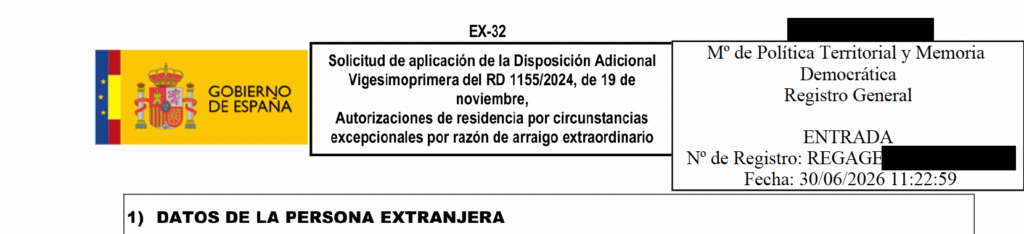
The first step is the issuance of the filing receipt and the assignment of an official case reference number by the Immigration Office.
From that moment, the application is formally registered in the system and can begin its administrative processing.
Processing times vary considerably depending on the province, as not all Immigration Offices operate at the same pace.
2. Admission for processing
One of the most significant milestones is the formal admission of the application for processing.
At this stage, the Immigration Office verifies that the application meets the minimum legal requirements to proceed with the substantive assessment.
In many cases, admission for processing also includes:
- The assignment of a Foreigner Identification Number (NIE), where the applicant did not previously have one.
- The automatic issuance of the official government fee payment forms required during the procedure.
Admission for processing also has an especially important practical consequence: applicants are authorized to work in Spain while their application is under review, in accordance with the legal framework governing this extraordinary regularization process.
For many applicants, this represents the first major milestone after months—or even years—of uncertainty.
3. Requests for additional documentation
Admission for processing does not mean that the application has been approved.
During the assessment phase, the Immigration Office may request additional documentation or clarifications if it considers that certain legal requirements need to be supported with further evidence.
These requests are relatively common in immigration procedures of this nature and must be answered within the deadline established by the Administration.
Providing a complete, well-prepared, and legally sound response is essential to avoid issues that could negatively affect the final decision.
4. Approval of the Residence Authorization
If the Immigration Office concludes that all legal requirements have been met, it will issue a favorable decision granting the corresponding temporary residence authorization.
The applicant may then proceed with the next administrative step: applying for their Foreigner Identity Card (TIE), thereby completing the regularization process.
5. Possible Refusal and Appeal options
Not every application will result in a favorable decision. If the Immigration Office determines that the legal requirements have not been met or that the supporting documentation is insufficient, it may issue a refusal.
However, a refusal does not necessarily mean the end of the process.
Every decision should be carefully reviewed to determine whether the authorities have correctly assessed both the facts and the evidence submitted.
Where sufficient legal grounds exist, applicants may file the appropriate administrative appeals or, where necessary, seek judicial review before the Spanish courts.
For this reason, continuous legal support throughout the entire process is particularly important, as a prompt and well-founded legal response can be decisive in protecting the applicant’s rights.
⏺️ The work continues
Although the application period has ended, our work certainly has not.
Over the coming months, we will continue to monitor every application individually, reviewing electronic notifications, responding to any requests for additional information, and supporting our clients until they obtain their residence authorization.
At the same time, we are already planning for the future.
The residence permits granted under this Extraordinary Regularization Process are temporary authorizations and will eventually need to be renewed or modified to ensure the continuity of lawful residence in Spain.
Planning for that next stage from the very beginning helps prevent future complications and ensures a smoother transition to subsequent residence authorizations with the highest possible level of legal certainty.
⏺️ A historic opportunity that marks a new beginning
The Extraordinary Regularization Process has represented a historic opportunity for thousands of people who have spent years building their lives in Spain.
The next phase is an administrative process that will require patience, continuous monitoring, and sound legal guidance until a final decision is reached.
At ARC Legal, we continue to support our clients throughout every stage of that journey because submitting the application was only the first step. Our commitment extends until every case reaches a successful outcome and continues through the future renewal or modification of the residence authorization, helping our clients build long-term stability and security in Spain.
⏺️ How ARC Legal can help
At ARC Legal, we provide comprehensive legal assistance throughout the Extraordinary Regularization Process, including monitoring applications, reviewing official notifications, responding to requests for additional documentation, filing administrative appeals where appropriate, and planning future residence renewals or modifications to ensure the continuity of your legal status in Spain.
If you need assistance with your immigration matter in Spain, our team will be pleased to help.
Related Articles
- Spain Immigration Regularization 2026: What changed in the latest Government update
- Extraordinary Regularization in Spain: How to demonstrate your eligibility
- Until When Can Applications for Spain’s Extraordinary Regularization Process Be Submitted?
¿Prefieres leer este artículo en español 🇪🇸? Puedes encontrarlo aquí: La Regularización Extraordinaria ha terminado. Ahora comienza la fase más importante
The information provided in this article is for general informational purposes only and does not constitute legal advice. Although we strive to keep our content accurate and up to date, Spanish immigration law is subject to legislative changes and interpretation by the competent authorities. For advice tailored to your specific circumstances, we recommend consulting a qualified immigration lawyer.