

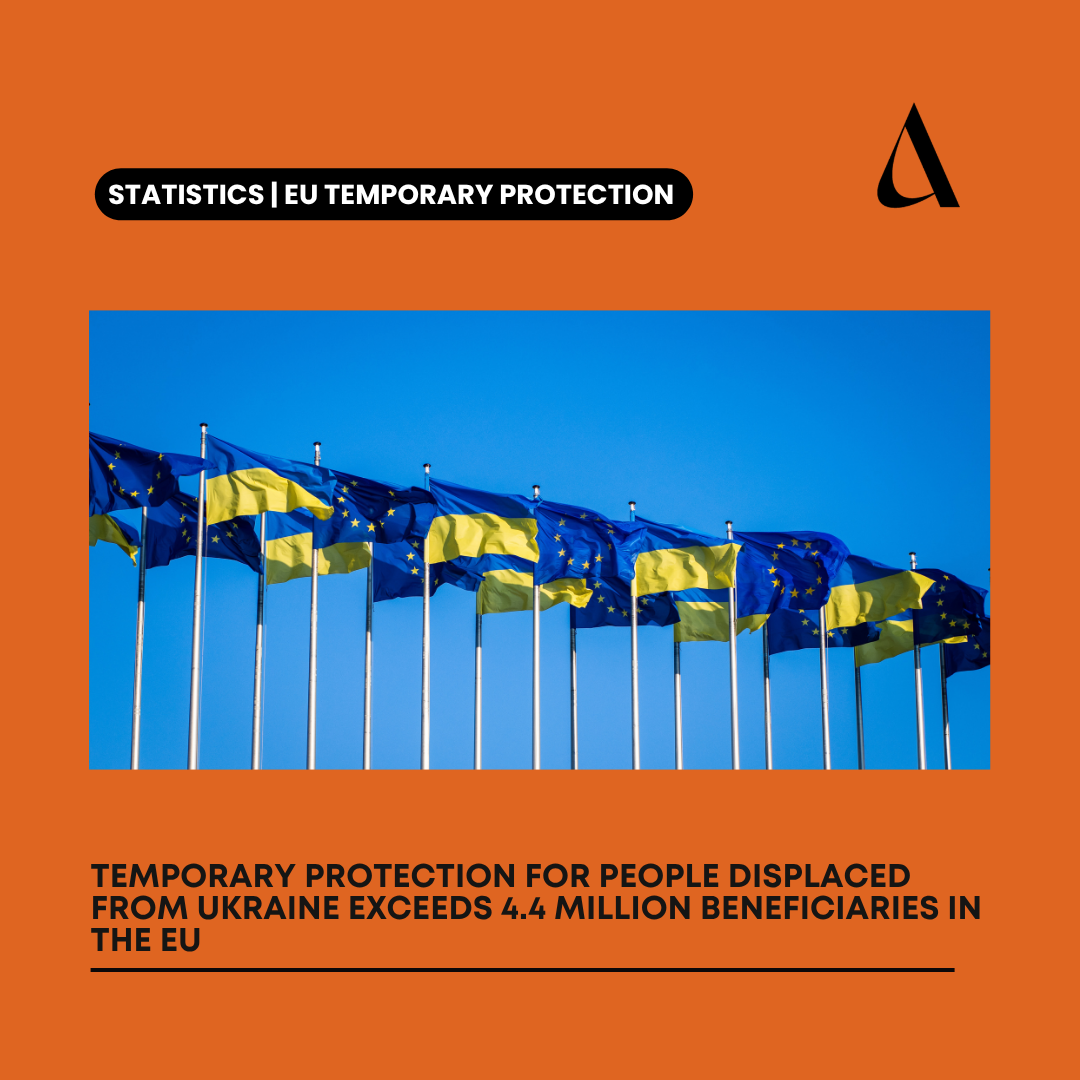
More than four years after the outbreak of the war, the temporary protection granted by the European Union to people displaced from Ukraine continues to be one of the main reception and residence mechanisms available in Europe.
According to the latest data published by Eurostat, as of July 31, 2026, 4,430,000 people held temporary protection status in the Member States. Compared with the previous month, the number of beneficiaries increased by 19,945 people, or 0.5%.
Although the monthly increase was moderate, the overall figure confirms that this extraordinary regime has become a long-term residence framework for millions of people.
⏺️ Germany remains the main host country
The distribution of beneficiaries remains particularly concentrated in Germany, Poland, and Czechia.
Germany was hosting 1,290,225 people, representing 29.1% of the total recorded in the European Union. Poland had 953,060 beneficiaries, while Czechia ranked third with 395,225 people.
Together, these three countries hosted more than half of all people under temporary protection in the European Union.
The ranking changes when the number of beneficiaries is compared with each country’s population. On this basis, Czechia had the highest proportion, with 36.2 people under temporary protection per 1,000 inhabitants. It was followed by Slovakia, with 27.5, and Cyprus, with 26.7, compared with an EU average of 9.8.
⏺️ The number of beneficiaries increases in most countries
The increase is not limited to the main host countries. Of the 26 Member States that reported comparable data, 23 recorded an increase during July.
The largest increases were recorded in:
- Czechia: 4,415 additional people.
- Romania: 4,055 additional people.
- Germany: 3,995 additional people.
In percentage terms, Romania recorded the most significant increase among these three countries, at 1.9%.
By contrast, the number of beneficiaries declined in Poland, France, and Cyprus. Poland recorded the largest decrease, with 8,110 fewer people than at the end of June.
⏺️ Women and minors represent the majority of beneficiaries
The demographic profile of beneficiaries remains relatively stable.
Ukrainian citizens represent more than 98.5% of the total. Adult women account for 43.4% of beneficiaries, while adult men represent 27.1%.
Minors account for 29.4% of the total.
These figures show that women and minors continue to represent almost three out of every four people covered by this regime, a composition closely linked to the characteristics of the displacement caused by the war.
⏺️ What is temporary protection?
Temporary protection is an exceptional mechanism created by the European Union to respond rapidly to situations involving the mass arrival of displaced people.
In the case of Ukraine, it was activated through Council Implementing Decision (EU) 2022/382 of March 4, following the recognition of a mass influx resulting from the war of aggression launched by Russia.
This system allows people falling within its scope to reside legally in the Member States and access certain rights without having to wait for an individual asylum procedure to be decided. Temporary protection also does not require each person to demonstrate individual persecution or a specific risk, since it is granted within the collective framework established by the European decision.
Temporary protection and international protection are different legal mechanisms.
Temporary protection is granted under an urgent collective system designed to address a mass displacement situation. An asylum application, by contrast, is an individual procedure in which the applicant’s personal circumstances and the risk they would face in their country of origin are examined.
Therefore, a person displaced from Ukraine may be legally protected without having applied for asylum. Each regime has its own requirements, documents, rights, and legal consequences.
💡 The European Union has agreed to extend temporary protection until March 4, 2028, extending the protection framework for people displaced from Ukraine for an additional year. More information is available in our article: link
⏺️ The importance of planning for the long term
Temporary protection provides an immediate and effective response, but it does not necessarily constitute a permanent immigration solution.
Beneficiaries may need specific legal advice if they wish to:
- Maintain and update their immigration documentation.
- Continue working legally in Spain.
- Reunite with or regularize certain family members.
- Study or start a professional activity.
- Switch to another residence authorization.
- Prepare their situation for when temporary protection comes to an end.
- Assess the consequences of returning to Ukraine or moving to another country.
The most suitable option will depend on each person’s personal, family, professional, and documentary circumstances.
⏺️ How ARC Legal can help
At ARC Legal, we advise people displaced from Ukraine and their family members on their residence and documentation options in Spain.
We can help you review your situation under the temporary protection regime, assess the procedures that may be required, and consider possible alternative residence options for the future.
If you need personalized legal advice regarding your situation in Spain, you can contact our firm.
Related publications
- The European Union extends temporary protection for people displaced from Ukraine until 2028
- More than 4.3 million Ukrainians remain under temporary protection in the European Union at the end of 2025
- Spain automatically extends temporary protection cards for people displaced from Ukraine until March 2027
Prefer to read this article in Spanish 🇪🇸? You can find it here: La protección temporal para personas desplazadas de Ucrania supera los 4,4 millones en la Unión Europea
The content of this article is provided for informational purposes only and does not constitute legal advice. Spanish immigration law is subject to ongoing changes in interpretation and administrative practice. At ARC Legal, we make every effort to keep our information up to date and based on official sources, but we always recommend consulting a specialized professional before starting any procedure or making any legal decisions. If you need personalized advice regarding your situation, you can contact our firm.