

Spain has become an increasingly important destination for international students wishing to pursue a PhD and develop an academic or research career. In fact, approximately 29.5% of all PhD students in Spain are international students. This means that almost 1 in every 3 PhD students comes from another country.
For international students, being admitted to a PhD programme involves more than simply arranging their enrolment at a university. It is also essential to determine which immigration authorization is required to legally reside in Spain while completing the PhD.
And since August 2026, there has been a particularly important development.
The Criterio de Gestión 2/2026 de la Dirección General de Gestión Migratoria (Management Criterion 2/2026 of the Directorate-General for Migration Management) establishes that certain foreign students admitted to official PhD programmes fall under the residence authorization for research regulated by Ley 14/2013 (Law 14/2013), rather than under a student stay authorization.
💡 If you would like to learn more about the student stay authorization in Spain, you can consult our Student Stay Permit in Spain | 2026 Guide, where we explain the requirements, application procedure, duration, financial requirements and right to work.
This change has important practical consequences. It affects the application procedure, the competent immigration authority and the rules applicable to key matters such as financial requirements, the duration of the authorization, the right to work and residence rights for family members.
⏺️ What residence authorization do international PhD students need in Spain?
This is one of the most significant developments introduced in 2026 and also one of the issues that raises the most questions among international students.
Although academically you are a PhD student, for immigration purposes certain international PhD students now fall under the residence authorization for research regulated by Ley 14/2013, rather than applying for a student stay authorization.
The Criterio de Gestión 2/2026 de la Dirección General de Gestión Migratoria (Management Criterion 2/2026 of the Directorate-General for Migration Management) establishes this regime for students admitted to official PhD programmes corresponding to Level 4 of the Marco Español de Cualificaciones para la Educación Superior (MECES – Spanish Qualifications Framework for Higher Education) and Level 8 of the European Qualifications Framework (EQF).
In these cases, the application is processed electronically before the Unidad de Grandes Empresas y Colectivos Estratégicos (UGE-CE – Large Companies and Strategic Groups Unit) as a national residence authorization for research.
This has a particularly important practical consequence:
- If you are already legally in Spain, you can apply directly for the residence authorization before the UGE-CE.
- If you are still living outside Spain, the residence authorization must first be obtained from the UGE-CE. Once approved, you can apply for the corresponding researcher visa at the competent Spanish Consulate.
⏺️ What requirements must a PhD student meet?
Although every application should be assessed individually, the main requirements include:
- Being admitted to a PhD programme that meets the applicable requirements.
- Being enrolled in the programme.
- Having paid the corresponding enrolment or registration fees.
- Having sufficient financial resources.
- Having valid healthcare coverage in Spain.
- Meeting the applicable criminal record requirements.
- Being legally present in Spain when the application is submitted from within Spain.
- Meeting the remaining general requirements established under Ley 14/2013.
💡 One of the most important aspects is preparing the university documentation correctly, as it must allow the authorities to verify both your admission and the characteristics of the PhD programme. The admission letter is not the only academic document you need to prepare. At the time of application, you must also provide evidence of your enrolment and payment of the corresponding registration or enrolment fees.
⏺️ Do I need to have paid my PhD enrolment fees before applying for residence?
Yes.
The specific instructions applicable to PhD students establish that, at the time the application is submitted, the student must demonstrate that they have been accepted into the programme and have paid the corresponding enrollment fees.
💡 Depending on the university, all this information may appear in a single certificate or may need to be demonstrated through several different documents.
⏺️ Financial requirements: how much money do I need?
This is one of the requirements that generates the most questions.
PhD students must demonstrate that they have sufficient financial resources for the requested period of residence and for their return to their country of origin.
As a minimum reference, where the student is moving to Spain alone, the UGE-CE requires resources equivalent to 50% of the Salario Mínimo Interprofesional (SMI – Spanish Minimum Wage), calculated on an annual basis.
It is important to distinguish between the amount used as the reference and the period that must actually be covered. The 50% SMI threshold is an annual reference, but the available financial resources must be sufficient for the entire period of residence requested.
💡 In 2026, 100% of the SMI is equivalent to €1,424.50 per month.
Depending on the individual circumstances, financial resources may be demonstrated through:
- Personal savings.
- Scholarships.
- Funding linked to the PhD programme.
- Financial support from family members, where properly documented.
⏺️ Is health insurance mandatory?
The student must have valid healthcare coverage in Spain.
Where private health insurance is used, the policy must be contracted with an insurance company authorized to operate in Spain and must meet the requirements applicable to this type of residence authorization.
Basic travel insurance is not sufficient.
It is also important to check the duration of the insurance coverage, particularly where the residence authorization is requested for an extended period.
💡 At ARC Legal Abogados, we can also assist you with obtaining appropriate health insurance, helping you choose a policy suitable for this type of authorization and avoid insurance policies that may cause problems during the application process.
⏺️ Do I need a criminal record certificate?
You must provide the corresponding criminal record certificate issued by the competent authorities of the relevant country or countries.
Foreign public documents must be duly apostilled or legalized, unless an applicable exemption exists, and accompanied by an official translation into Spanish where required.
⏺️ Can I apply for the PhD residence authorization from within Spain?
Yes.
If you are already legally in Spain, you can submit the residence application electronically before the UGE-CE, provided that you meet the applicable requirements.
This is particularly relevant for students who are already in Spain under a student stay authorization and subsequently begin a PhD programme.
In these cases, it is important to review:
- Your current immigration authorization.
- Its expiry date.
- Your legal status in Spain.
- The starting date of your PhD programme.
- The documentation issued by the university.
💡 You do not automatically need to leave Spain to apply for the new authorization if the application can be properly submitted while you are legally present in Spain.
⏺️ How do I apply if I am still outside Spain?
You can also begin the procedure while you are still living outside Spain.
In this situation, it is particularly important to follow the procedure in the correct order.
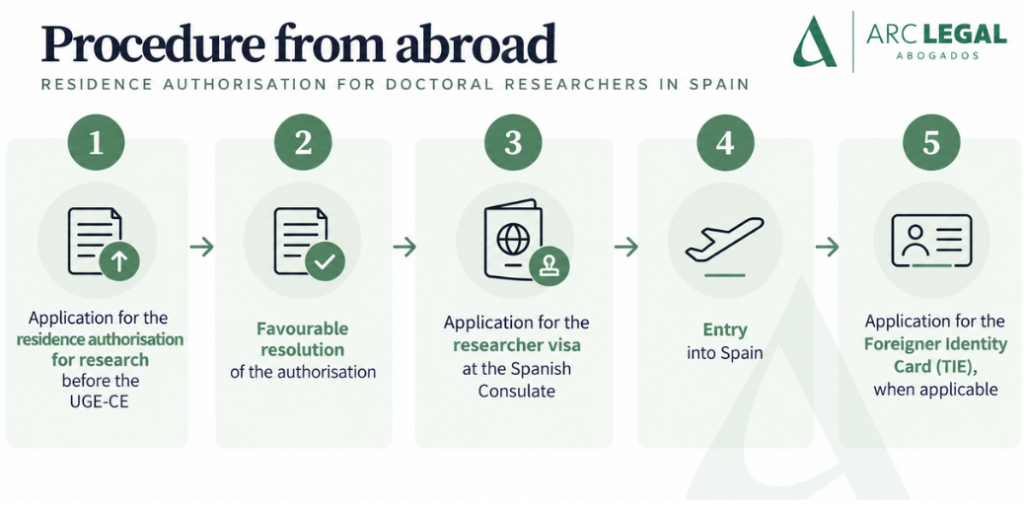
This means that, if your PhD falls within this immigration regime, the procedure does not begin by applying directly for a student visa at the Spanish Consulate.
The residence authorization must first be processed before the UGE-CE.
This distinction is particularly important for students who are still in their country of origin and are preparing to move to Spain.
⏺️ How long does the PhD residence application take?
One of the main advantages of residence authorizations regulated by Ley 14/2013 is their expedited processing procedure.
The statutory processing period for a residence authorization for research is 20 working days. In addition, Ley 14/2013 provides for positive administrative silence for these authorizations.
💡 The statutory processing period should not be confused with the time required to prepare the application beforehand. Before filing, you may need to obtain documentation from the university, formalise and pay your enrolment, obtain criminal record certificates, arrange health insurance or properly prepare evidence of your financial resources.
For this reason, particularly where the student is outside Spain and will subsequently need to apply for a visa, we recommend planning the procedure sufficiently in advance.
⏺️ How long is the residence authorization for a PhD student valid?
PhD programmes normally last several years, and the documentation submitted to the UGE-CE should allow the authorities to properly determine the expected duration of the programme.
💡 We therefore recommend that, whenever possible, the certificate issued by the university indicates the duration of the PhD programme or its expected start and completion dates.
The specific duration of the residence authorization will depend on the individual circumstances and the documentation submitted.
This also has an important practical consequence: where an authorization is requested for a period of several years, it is necessary to ensure that the remaining requirements are properly demonstrated for the period requested.
⏺️ Can I work while completing my PhD?
This is one of the most important differences compared with the student stay regime.
PhD students falling within this regime obtain a residence authorization for research under Law 14/2013, rather than a student stay authorization.
Therefore, the 30-hour weekly limit applicable to holders of certain student stay authorizations should not automatically be applied to these PhD students.
This makes the new regime particularly relevant for PhD students who, in addition to carrying out their research, wish to continue developing their professional careers while living in Spain.
⏺️ Can my family come with me to Spain?
Yes.
Law 14/2013 allows certain family members to accompany the holder of the residence authorization.
These may include:
- Spouse.
- Partner in a relationship equivalent to marriage.
- Minor children.
- Certain adult children who are financially dependent on the main applicant.
- Certain dependent ascendants.
Each family member’s individual circumstances must be assessed, and the relevant family relationship must be properly documented.
In addition, where the student moves to Spain accompanied by dependent family members, higher financial resources will need to be demonstrated.
💡 If you are planning to move to Spain with your family, we recommend assessing the applications together from the outset and sufficiently in advance, as accompanying family members affect both the documentation and the financial resources that must be demonstrated.
⏺️ Can family members work in Spain?
Yes.
This is another important difference compared with the regime applicable to family members of students.
Residence authorizations granted to family members under Law 14/2013 allow them to reside and work in Spain, subject to the applicable legal requirements.
This can be particularly important where a PhD student moves to Spain with a spouse or partner who wishes to continue their professional activity in Spain.
⏺️ Do I need to apply for a TIE?
Where the duration of the authorization requires a Tarjeta de Identidad de Extranjero (TIE – Foreigner Identity Card), you will need to complete this procedure after obtaining the residence authorization.
If you have completed the procedure from abroad, the TIE will be processed after obtaining the residence authorization, applying for the corresponding visa and entering Spain.
It is important not to confuse these two procedures.
The decision issued by the UGE-CE grants your residence authorization, whereas the TIE is the physical identity card that subsequently evidences your immigration status in Spain.
💡 At ARC Legal, we can also assist you with obtaining your Tarjeta de Identidad de Extranjero (TIE) once your residence authorization has been granted.
⏺️ How can ARC Legal Abogados help you?
Completing a PhD in Spain involves much more than securing a place at a university. Academic admission and the immigration procedure are separate processes, and following the changes introduced in 2026, it is particularly important to identify the correct immigration authorization before beginning the process.
At ARC Legal Abogados, we assist international PhD students throughout the entire Spanish residence procedure, whether they are already in Spain or are still preparing to move from abroad.
We can assist you from the initial stages — reviewing your PhD programme and the documentation issued by the university — through to the procedures required after your residence authorization has been granted.
Our goal is to ensure that you do not have to worry about determining the correct immigration procedure or managing each of the necessary administrative steps. We take care of the procedure so that you can focus on what matters most: your PhD and your academic and professional career in Spain.
Related publications
- Foreign PhD students must apply for a residence authorization for research
- How to apply from abroad for a residence authorization to complete a PhD in Spain
- PhD students and researchers in Spain: the new residence permit and its impact on Spanish nationality
Prefer to read this article in Spanish 🇪🇸? You can find it here: Residencia para estudiantes de doctorado en España | Guía 2026
The content of this article is provided for informational purposes only and does not constitute legal advice. Spanish immigration rules are subject to ongoing changes in interpretation and administrative practice. At ARC Legal, we make every effort to keep our information up to date and verified against official sources, but we always recommend consulting a specialised professional before starting any procedure or making legal decisions. If you require personalised advice regarding your situation, you can contact our law firm.