


Have you received a favorable resolution granting Spanish nationality and don’t know what comes next? Would you like to come with us to a “pre-jura” and nationality oath appointment at the Madrid Central Civil Registry and understand the entire process in detail?
At ARC Legal, we accompany our clients through this final stage of the process, and we know it is one of the most exciting — but also one of the most unfamiliar. In this article, we explain step by step what the pre-jura is, what happens on the day of the oath, and which documents you need to ensure everything goes smoothly.
⏺️ What happens once nationality is granted?
Receiving Spanish nationality by residence is not the end of the process, but rather the beginning of a crucial new phase: the oath or promise of allegiance to the King and obedience to the Spanish Constitution and Laws. This formal act is essential for the nationality to take full effect. Until the oath is performed (and the registration in the Civil Registry is completed), you won’t be able to obtain your Spanish ID card (DNI) or passport.
Currently, there are two ways to perform the oath:
- Before the Civil Registry corresponding to your place of residence, which is the most traditional option but often involves longer wait times to get an appointment, especially in high-demand cities.
- Before a notary, under Law 20/2011 on the Civil Registry. This option can be quicker in some cases, although the notary must later forward the oath record to the Civil Registry for official registration.
💡 At ARC Legal, we help you assess which option is most appropriate in your case, depending on your location and deadlines. In both scenarios, it’s crucial to prepare the documentation correctly and not exceed the legal six-month deadline to complete the procedure. We handle the appointments for you, so you don’t have to worry about anything.
In many cities — such as Madrid — you will first need to attend a preparatory appointment known as the pre-jura, an essential organizational step before the final oath.
⏺️ What is the pre-jura and what is it for?
The “pre-jura” is a preliminary step used by some Civil Registries, especially in cities with a high volume of applications like the Madrid Central Civil Registry, to organize and speed up the oath process. It is not formally regulated by law, but has become a common practice to screen documents and prepare the final act.
It is important to attend the pre-jura with the documents that may be required: the resolution granting nationality, your criminal record certificate and literal birth certificate (both duly legalized or apostilled and translated, if applicable) that were submitted during your nationality application, your complete passport, your foreigner ID card (TIE), and a current certificate of registration with the city hall (empadronamiento). Each Civil Registry may request additional documents, so it is best to check beforehand.
During the pre-jura:
- It is verified that nationality has been granted and that all documentation is complete and correctly legalized or translated.
- It is confirmed that you are within the 180-day legal deadline from the notification of the resolution. However, this requirement is often interpreted flexibly due to the widespread difficulty in securing an appointment.
- You choose the order and composition of your surnames, based on your country of origin’s birth certificate and your personal preference. For certain nationalities where the maternal surname does not appear, an official document showing it may be required.
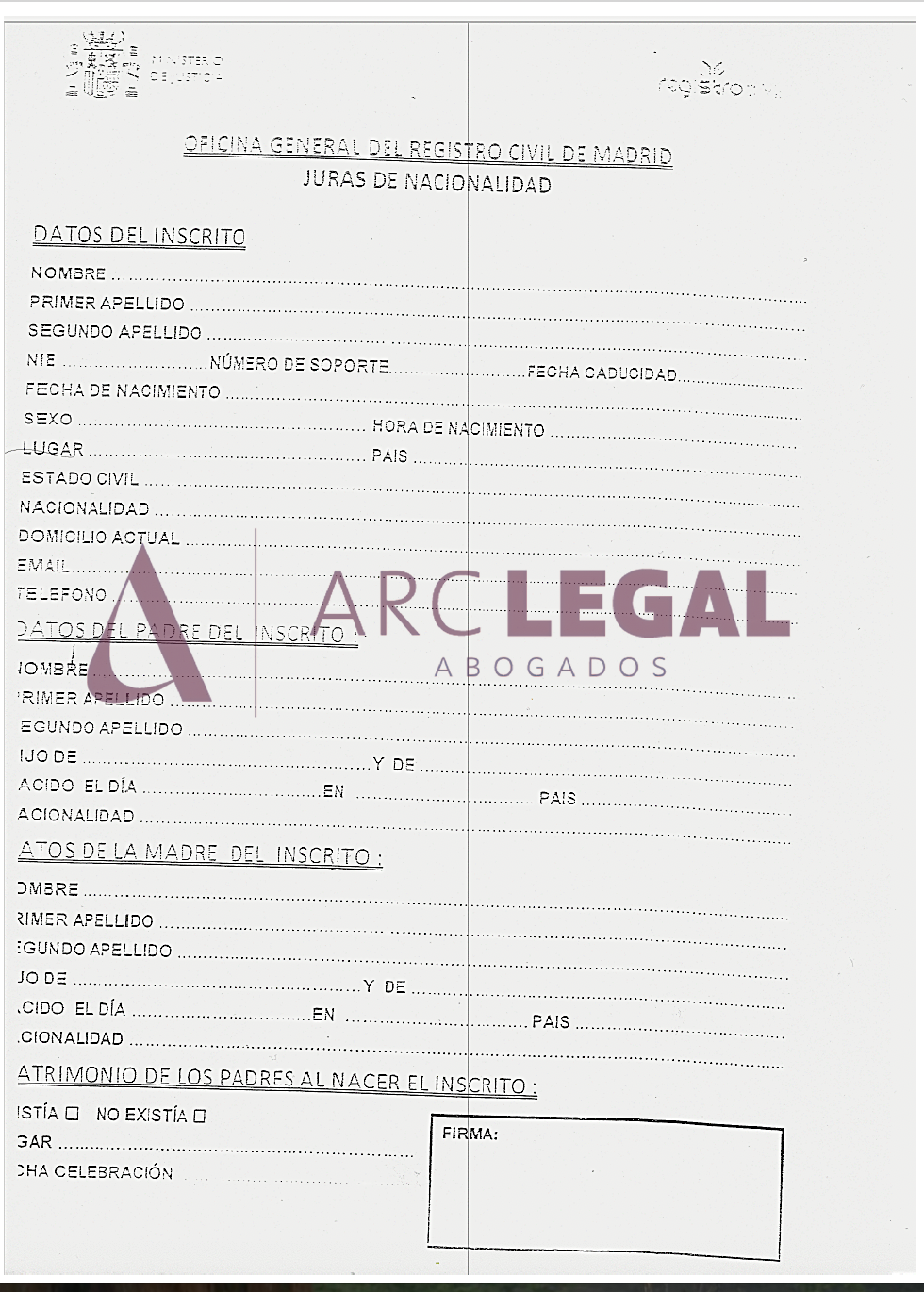
- In some registries, such as in Madrid, a data form is also provided during the pre-jura appointment. This must be filled out and submitted on the day of the oath. It typically includes the details that will be entered into the Civil Registry (name, surnames, place of birth, parentage, etc.), so it is important to complete it carefully and keep it safe.
- The appointment for the final oath is scheduled.
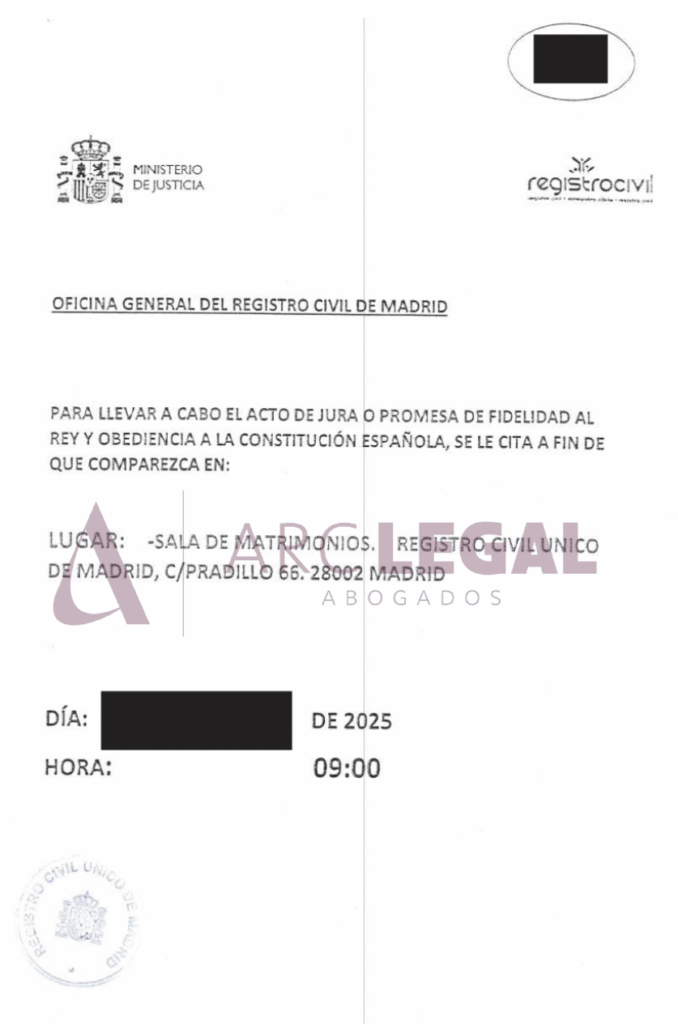
💡 In the case of the Madrid Central Civil Registry, the final oath appointment is usually set for the next day or a few days later, and the data form is also provided during the pre-jura. This system helps speed up the process and ensures that both steps — pre-jura and oath — are completed within a short timeframe, provided your documentation is in order.
Although it may seem like just another bureaucratic step, the pre-jura is key to ensuring everything is in place on the day of the oath. Being well-prepared avoids delays and ensures correct registration in the Civil Registry, as any errors or missing documents can slow things down.
⏺️ What happens on the day of the oath?
The oath (or promise) is a personal act performed before the Civil Registry officer, where the applicant explicitly declares:
- Their willingness to acquire Spanish nationality.
- Their commitment of allegiance to the King and obedience to the Constitution and laws.
- And, where applicable, the renunciation of their previous nationality, except for nationals of countries with a bilateral agreement allowing them to retain it (such as Latin American countries, Andorra, the Philippines, Guinea Equatorial, Portugal, or Sephardic Jews).
This is a solemn act, usually conducted individually or in small groups. In some registries, the oath document is signed the same day; in others, the process continues later with registration.
💡 In the Madrid Central Civil Registry, oaths usually take place early in the morning and are organized in large groups — typically over 75 people. The ceremony lasts about one hour and proceeds quickly: as each person finishes, they may leave. On this day, it is not necessary to bring all the documents again; you only need to present a valid ID (passport or TIE) and the documents provided to you during the pre-jura.
⏺️ How long does the process take?
- Getting a pre-jura appointment can take weeks or months, depending on the city.
- After the oath, the corresponding Civil Registry must register your nationality and issue your Spanish birth certificate, which is required to apply for your DNI and passport.
- The time to obtain the birth certificate varies — from a few days to several months.
⏺️ What if I don’t do the oath in time?
Spanish law sets a maximum deadline of 180 calendar days from the date of the resolution to complete the oath. If the oath is not completed within that period, the granted nationality may become void. That’s why planning ahead and receiving proper legal advice is essential.
⏺️ Our advice
The pre-jura and oath are the final steps to becoming a Spanish citizen. Although it may seem simple, each Civil Registry operates differently and mistakes or delays are common.
At ARC Legal, we accompany you through the entire process: from preparing your documents for the nationality application to the final oath and issuance of the birth certificate — including the submission of your file, appointment scheduling, and resolving any issues along the way. Would you like to attend a pre-jura or oath appointment with us? We’ll be by your side to make this last step as clear and smooth as the first. You can contact us directly or fill in the following form, and we’ll get back to you as soon as possible.
Related articles
- Spanish Nationality by residency – Second quarter 2025 overview
- Submit your Spanish nationality application through the platform enabled by the Bar Association
- Success Story: Obtaining a Police Clearance Certificate from the UAE for a Spanish Nationality process
Prefer to read this article in Spanish 🇪🇸? Puedes leerlo aquí: ¿Has recibido la nacionalidad española? Así es la prejura y jura ante el Registro Civil
The content of this article is for informational purposes only and does not constitute legal advice. Immigration regulations are subject to frequent interpretative and administrative changes. At ARC Legal, we do our best to ensure that the information is updated and verified against official sources, but we always recommend consulting with a specialized professional before starting any procedure or making legal decisions. If you need personalized advice, feel free to contact our office.