

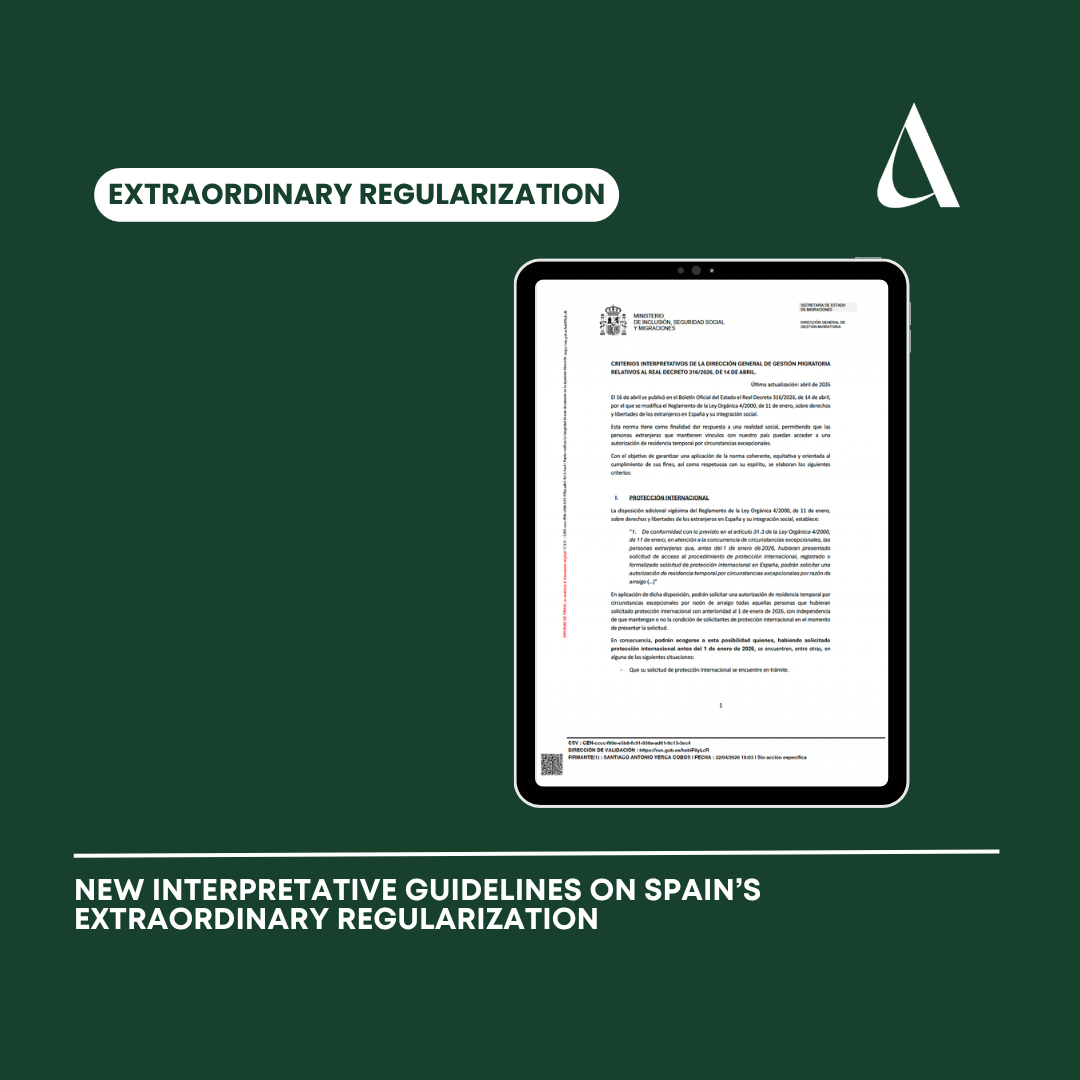
The Secretary of State for Migration, through the Directorate General for Migration Management, has published the first interpretative guidelines regarding Royal Decree 316/2026.
This document is particularly relevant from a practical standpoint. It does not modify the law, but it clarifies how it will be applied in the actual processing of applications—something essential in a procedure where many aspects were previously open to interpretation.
Below, we outline these guidelines and analyze the most relevant points and their practical implications.
⏺️ International Protection: a broad interpretation
One of the most important aspects is the interpretation of the twentieth additional provision.
The Directorate General confirms that individuals who applied for international protection before January 1, 2026 may access this regularization pathway, regardless of their current status. This includes both pending applications and cases that have already been decided or are under appeal.
In practice, this means that the following situations are included:
– Pending international protection applications
– Applications that have already been denied
– Administrative or judicial appeals that are still ongoing
– Cases where the applicant previously withdrew their application
This is a broad interpretation that strengthens the scope of the measure and includes situations that previously raised uncertainty.
⏺️ Vulnerability report: when is it actually required?
Another key issue that has generated significant uncertainty in practice is the vulnerability report, which we have already addressed at ARC Legal in our article on vulnerability in the extraordinary regularization process.
The guidelines clearly establish that this report is only required when the application is based on the vulnerability pathway. In other words, it is not necessary if the applicant qualifies through employment or family ties.
This clarification is particularly important, as it allows for a more accurate strategy from the outset and avoids restrictive interpretations.
⏺️ Issuance of the report: practical considerations
The guidelines also provide important clarifications regarding how the vulnerability report must be issued.
It may only be issued by entities registered in the Electronic Registry of Immigration Collaborating Entities, as well as by public authorities responsible for social services. In addition, the report must be issued free of charge and comply with certain formal requirements.
In practice, this means that not every report will be valid, making it essential to ensure that it is obtained through the appropriate channels.
⏺️ A key recommendation: do not give up other options
From a strategic perspective, one of the most important messages in these guidelines is the recommendation not to withdraw pending applications or renounce existing residence permits.
This reinforces a fundamental idea: extraordinary regularization should not be considered in isolation, but as part of a broader strategy. In many cases, different pathways may coexist, and it is necessary to determine the most appropriate one.
⏺️ Transitional regime: simplification in certain cases
Regarding applications already in process, the guidelines introduce an interpretation that simplifies the requirements in certain cases, focusing on two key elements: the absence of a criminal record and the fact that the applicant does not pose a threat to public order.
This point may have a direct impact on applications that have already been submitted or are currently under review.
⏺️ What do these guidelines mean in practice?
Although these guidelines do not change the content of the Royal Decree, they do determine how it will be applied in practice.
They provide greater clarity, reduce uncertainty, and highlight the importance of preparing each application strategically.
The key is no longer just meeting the requirements, but understanding how to demonstrate them and which pathway is most appropriate.
⏺️ How can ARC Legal Abogados assist you?
The publication of these guidelines confirms that extraordinary regularization is not an automatic process.
Each case must be analyzed individually, taking into account both the legal framework and the interpretative guidelines that are shaping its practical application.
At ARC Legal, we help you define the best strategy for your case, identify the most suitable pathway, and prepare your application thoroughly, anticipating potential issues during the process.
If you would like to understand how these guidelines affect your case or whether you may qualify for extraordinary regularization, feel free to contact us.
Related publications
- How long does it take to get a decision on Extraordinary Regularization in Spain?
- Extraordinary Regularization in Spain: How to demonstrate your eligibility
- When can you start working in Spain during the Extraordinary Regularization process?
¿Prefieres leer este artículo en español 🇪🇸? Aquí te dejamos el enlace: Nuevos criterios interpretativos sobre la Regularización Extraordinaria
The information provided in this article is for informational purposes only and does not constitute legal advice. While we strive to provide accurate and up-to-date information, immigration regulations are subject to change and interpretation by the competent authorities. For personalized and up-to-date advice, we recommend consulting a qualified immigration lawyer.