

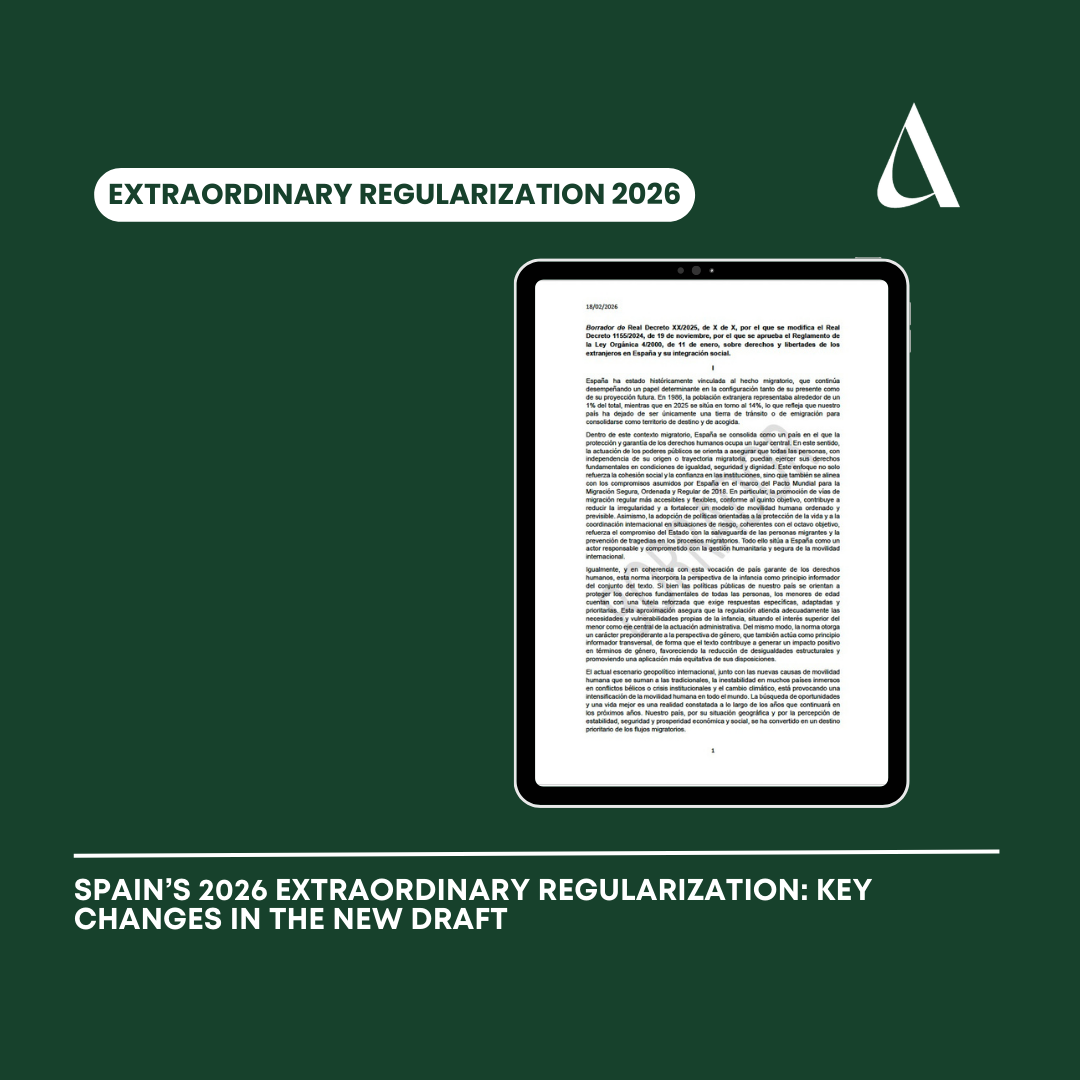
The extraordinary regularization planned for 2026 continues to move forward. Following the public consultation phase, the Government has released a new version of the draft Royal Decree introducing significant changes compared to the initial text. This new document goes beyond technical adjustments. It strengthens requirements, redefines incompatibilities, refines eligibility criteria, and also introduces amendments to the current Immigration Regulation itself.
The information set out below is based exclusively on the Draft Royal Decree currently under legislative process. As this is still a provisional text, its content may be modified before final approval.
This is particularly important for two reasons:
- It confirms that the measure is moving forward and remains on the legislative agenda.
- The final design will not be neutral: certain profiles may be excluded if proper planning is not carried out.
Many individuals are waiting for this regularization as a potential opportunity. However, the new draft makes clear that it will not be an automatic or generalized pathway. It will involve defined filters, clear limitations, and specific evidentiary requirements. Understanding the changes introduced after the public consultation phase is therefore essential in order to anticipate strategic decisions.
Below, you can access the draft published following the public consultation phase (in Spanish):
⏺️ Draft structure
The second draft does more than refine requirements. It technically restructures the regularization into three major regulatory blocks:
- A specific transitional provision for asylum applicants.
- A new extraordinary “arraigo” pathway.
- Partial amendments to the current Immigration Regulation.
Each of these blocks has different implications and will affect different profiles. Below is a preliminary overview.
⏺️ Transitional Provision Five: asylum applicants
The draft regulates a specific framework for individuals who applied for international protection before the established cut-off date.
Among the most relevant elements:
- Clear delimitation of the temporal scope of eligibility.
- Introduction of prior stay requirements in Spain.
- Reinforced background checks and incompatibility controls.
- Provisional authorization to reside and work upon admission of the application.
This provision is designed to channel situations arising from denied or pending asylum applications, while introducing safeguards to prevent overlap with other immigration pathways.
⏺️ Transitional Provision Six: extraordinary arraigo
The second major block introduces a residence authorization based on extraordinary social integration.
This is not a new ordinary arraigo category, but rather a temporary and exceptional figure intended to address situations that do not clearly fit within the current regulatory framework.
The draft structures this authorization around three potential scenarios:
- Having carried out work activity in Spain or demonstrating a genuine expectation of entering the labor market.
- Cohabitation with immediate family members in Spanish territory.
- Being in a duly accredited situation of vulnerability.
However, the draft does not establish a broad or automatic pathway. On the contrary, it sets clear limitations:
- Prior physical presence in Spain is required.
- Access is blocked if other residence procedures are already pending.
- Background checks and incompatibility rules are reinforced.
- Access depends on an individualized assessment of each case.
From a practical standpoint, this provision may become an important tool for certain profiles, but it will not operate as a general solution. Its real scope will largely depend on how concepts such as work activity, family unit, and vulnerability are interpreted in administrative practice.
⏺️ Amendments to the Immigration Regulation: changes beyond the Extraordinary Regularization
The draft does not limit itself to regulating the extraordinary regularization. It also introduces direct amendments to the current Immigration Regulation (Royal Decree 1155/2024).
This means that the impact will not be confined to those applying under the regularization, but may also affect existing ordinary procedures.
The areas potentially impacted include:
- Adjustments to the social arraigo regime, including clearer economic requirements.
- New rules to prevent simultaneous or overlapping immigration procedures.
- Amendments affecting family members of Spanish nationals.
- Technical clarifications that may influence modification or renewal applications.
These changes are not minor. Introducing structural reforms within an extraordinary measure may generate indirect consequences for cases unrelated to the regularization itself.
From a practical perspective, this requires a review of ongoing strategies. Individuals currently applying for arraigo, modification of status, or residence as family members of Spanish nationals may be affected if the draft is approved in its current terms.
⏺️ How ARC Legal Abogados can assist you
The extraordinary regularization 2026 will not be automatic. Access will depend on details: dates, proof of physical presence, background checks, pending procedures, and prior strategic decisions.
At ARC Legal Abogados, we can assist you in:
- Analyzing your current immigration status and identifying potential incompatibilities.
- Designing a legal strategy before the final text is approved.
- Assessing whether to maintain an ongoing procedure or wait for the regularization.
- Preparing in advance the documentation required to prove residence and social integration.
- Avoiding timing mistakes that could exclude you from the future measure.
Our firm is conducting a comparative review of each draft version in order to anticipate scenarios and provide strategic advice, not just procedural filing.
In extraordinary procedures, the difference is often in the planning.
If you would like to understand how this future regularization may affect your situation and which pathway is most suitable in your case, you can contact our team for a detailed assessment.
Related Publications
- Extraordinary Regularization 2026: Practical analysis for asylum applicants
- Extraordinary Regularization 2026: Government indicates timeline around April
- Extraordinary Regularization 2026: Key dates to apply for residence in Spain
¿Prefieres leer el artículo en español 🇪🇸? Aquí te dejamos el artículo: Regularización extraordinaria 2026: el Gobierno publica un segundo borrador con cambios relevantes
The information provided in this article is for informational purposes only and does not constitute legal advice. While we strive to provide accurate and up-to-date information, immigration regulations are subject to change and interpretation by the competent authorities. For personalized and current legal advice, we recommend consulting with a qualified immigration attorney.