

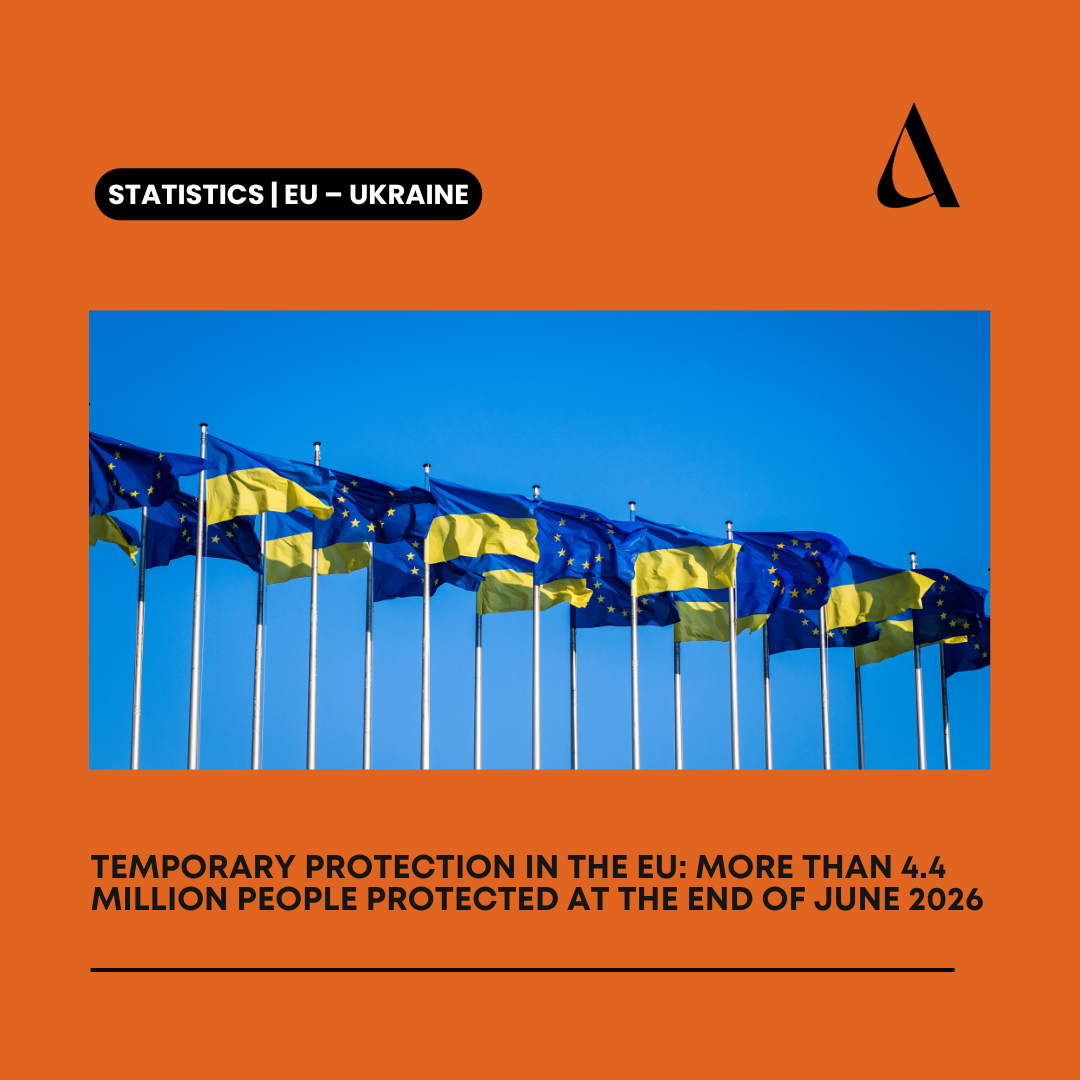
The temporary protection granted by the European Union to people displaced from Ukraine continues to grow. By the end of June 2026, the number of beneficiaries had reached 4.41 million, remaining at historically high levels more than four years after this exceptional mechanism was activated.
The latest data published by Eurostat show another monthly increase, albeit a moderate one, and confirm a trend that has become increasingly clear in recent months: temporary protection is no longer responding solely to an initial emergency situation but has become a long-term residence framework for millions of people across the European Union.
⏺️ More than 4.4 million people under temporary protection
As of June 30, 2026, a total of 4.41 million non-EU citizens displaced from Ukraine held temporary protection status in the European Union. Compared with the end of May 2026, this figure increased by 24,380 people, representing monthly growth of 0.6%.
Although the increase is moderate, the figures confirm that the total number of beneficiaries continues to grow and remains clearly above 4.4 million.
⏺️ Germany and Poland account for more than half of all beneficiaries
The distribution of beneficiaries continues to show a significant concentration in certain Member States.
Germany remains by far the main host country, followed by Poland and Czechia:
- Germany: 1,286,230 beneficiaries, representing 29.2% of the EU total.
- Poland: 961,170 beneficiaries, representing 21.8%.
- Czechia: 390,810 beneficiaries, representing 8.9%.
Together, these three countries account for almost six out of every ten people benefiting from temporary protection across the European Union.
However, when the number of beneficiaries is considered in relation to the population of each Member State, Czechia ranks first, with 35.8 beneficiaries per 1,000 inhabitants. It is followed by Slovakia, with 27.2, and Cyprus, with 26.8, compared with an EU average of 9.8.
⏺️ Temporary protection increases in 24 of the 27 Member States
During June, the number of beneficiaries increased in 24 of the 27 Member States, showing that growth continues to be widespread across almost the entire European Union.
The largest absolute increases were recorded in:
- Italy: +4,115 people (+8.8%).
- Czechia: +3,835 (+1%).
- Germany: +2,960 (+0.2%).
Italy stands out in particular, not so much because of its total number of beneficiaries, but because of the significant growth recorded during the last month.
Only three Member States recorded decreases. Poland experienced the most significant decline, with 6,335 fewer beneficiaries (-0.7%), while the changes recorded in Belgium (-35) and Ireland (-15) were practically negligible.
⏺️ A demographic profile that remains stable
The demographic composition of beneficiaries remains very similar to that observed in previous months.
More than 98.5% are Ukrainian citizens. By demographic group:
- Adult women represent 43.4% of the total.
- Minors account for 29.6%.
- Adult men represent 27%.
Women and minors therefore continue to represent almost three quarters of all people benefiting from this protection regime across the European Union.
⏺️ A mechanism that has become increasingly structural
Temporary protection was activated through Council Implementing Decision (EU) 2022/382 in response to the mass influx of people displaced from Ukraine following the outbreak of the war.
More than four years later, the figures show the extent to which this exceptional instrument has become a long-term migration reality within the European Union.
💡 The European Union has recently agreed to extend temporary protection until March 4, 2028, providing an additional year of protection for people displaced from Ukraine. Find out more in our article: link
The evolution is particularly significant when looking at the total number of beneficiaries: rather than showing a general decline, the figure continues to increase gradually and has now exceeded 4.4 million people.
⏺️ Temporary protection and the debate about its future
The temporary protection regime now has a defined short-term legal horizon, but the question of what will happen afterwards is becoming increasingly important.
The continuation of this mechanism for several years creates a very different scenario from the one that existed in 2022. Many of those initially displaced have developed employment, professional, academic and family ties in the Member States where they currently reside.
For this reason, the European debate is gradually shifting beyond the continuation of temporary protection itself and toward how an orderly transition should eventually be structured for those who may qualify for other residence pathways and for those who, when circumstances allow, decide to return to Ukraine.
The June figures once again highlight the scale of this challenge: any future transition will have to address the legal situation of more than 4.4 million people currently protected across the European Union.
⏺️ How ARC Legal can help
At ARC Legal, we advise foreign nationals and companies on immigration procedures, international mobility and immigration law. If you have questions about temporary protection, residence permits or any other immigration procedure in Spain, our team can help you assess your situation and determine the most appropriate strategy for your case.
Related articles
- The European Union extends temporary protection for people displaced from Ukraine until 2028
- More than 4.3 million Ukrainians remain under temporary protection in the European Union at the end of 2025
- Spain automatically extends temporary protection cards for people displaced from Ukraine until March 2027
¿Prefieres leer este artículo en español 🇪🇸? Puedes encontrarlo aquí: La protección temporal en la UE alcanza los 4,41 millones de beneficiarios a finales de junio de 2026
The content of this article is for informational purposes only and does not constitute legal advice. Immigration regulations are subject to ongoing legal, administrative and interpretative changes. At ARC Legal, we make every effort to keep our information up to date and verified against official sources. However, we always recommend consulting a specialized professional before starting any procedure or making legal decisions. If you need advice tailored to your situation, you can contact our firm.