

At the end of November 2025, the temporary protection granted by the European Union to people displaced from Ukraine presents a clear picture: the system remains in place, but has entered a phase of lower intensity in terms of new grants, while the total number of protected persons continues to stand at historically high levels.
The figures confirm that the initial emergency phase has given way to a more structural scenario, in which millions of people continue to reside across Europe under an exceptional legal regime that has now been in force for more than three years.
⏺️ A stable figure above 4.3 million people
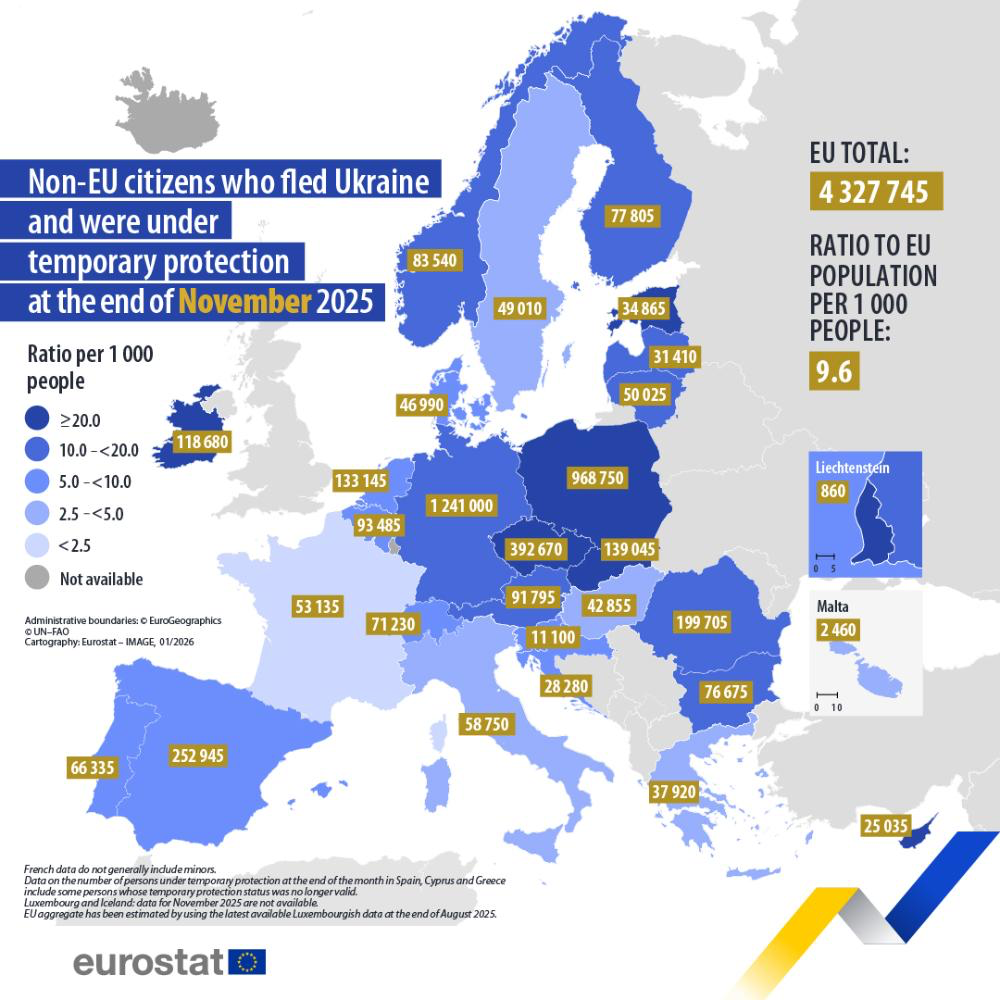
As of 30 November 2025, 4.33 million third-country nationals who fled Ukraine were holding temporary protection status in the European Union, according to Eurostat data. This represents an increase of 30,615 people compared to the end of October, equivalent to a rise of 0.7%.
The increase is moderate, but sufficient to confirm that the system has neither been closed nor frozen. Temporary protection continues to absorb new beneficiaries, although no longer at the intensity observed following certain political and regulatory developments in 2024 and 2025.
⏺️ Reception remains concentrated in Central and Eastern Europe
The territorial distribution of protected persons shows little variation. Germany, Poland, and Czechia remain the three main host countries, together accounting for more than six out of every ten beneficiaries across the EU.
Germany hosts 1,241,000 beneficiaries, representing 28.7% of the EU total.
Poland hosts 968,750 people (22.4%).
Czechia accounts for 392,670 people (9.1%).
This long-standing concentration has clear implications in terms of labor market integration, pressure on public services, and the design of long-term migration policies.
⏺️ Increases in most Member States, with Spain among the fastest-growing
Of the 26 Member States with available data, 21 recorded increases during November. The largest absolute increases were observed in Germany, Poland, and Spain.
The Spanish case is particularly noteworthy: with an increase of 2,810 people (+1.1%), Spain continues to consolidate its position as one of the countries where temporary protection numbers are still rising, in contrast with other Member States where declines are beginning to emerge.
💡 For further context, you can read this article: More than 326,000 Ukrainians currently hold valid residence permits in Spain
At the opposite end, France and Lithuania registered the most significant decreases, pointing to processes of secondary movement, returns, or changes in administrative status.
⏺️ A significant drop in new grants
The most revealing data point for the month is not the total stock, but the number of new decisions. In November 2025, 53,735 new temporary protection decisions were issued, a figure significantly lower than in September and October.
The reduction—exceeding 30% compared to September—brings new grants back to levels similar to those seen before the Ukrainian government decree adopted at the end of August 2025, which allowed men aged 18 to 22 to leave the country without restrictions.
This adjustment suggests that the impact of that measure has now been absorbed and that the system has entered a phase of greater predictability.
⏺️ A clearly defined demographic profile
The composition of beneficiaries shows little change compared to previous months:
- More than 98.4% are Ukrainian nationals.
- Adult women account for 43.6%.
- Minors represent 30.7%.
- Adult men account for 25.7%.
This demographic profile continues to shape public policy responses, particularly in education, healthcare, and social support systems.
⏺️ A legal framework extended until 2027
All of these figures fall within the application of the Implementing Decision that first activated the temporary protection mechanism in response to a mass influx of displaced persons.
In addition, the European Council agreed on 13 June 2025 to extend the regime until 2027, removing any short-term uncertainty regarding its continuity.
The key question is no longer whether temporary protection will continue, but what will come next—and how the transition toward more stable residence solutions will be structured.
⏺️ How ARC Legal can support you
At ARC Legal, we assist individuals and families in understanding their migration status and the options available under Spanish immigration law at each stage. We assess each case individually to help clients make informed decisions and plan their next steps with greater legal certainty.
If you need professional guidance regarding your situation in Spain, you can get in touch with our team.
Related publications
- Extension of temporary protection for displaced persons from Ukraine until March 2027
- EU Council Recommendation on the transition after Temporary Protection for Ukrainians
- More than 326,000 Ukrainian nationals hold valid residence permits in Spain
¿Prefieres leerlo en español 🇪🇸? Puedes encontrarlo aquí: Protección temporal en la UE: balance de noviembre de 2025 para las personas desplazadas desde Ucrania
The content of this article is for informational purposes only and does not constitute legal advice. Immigration law is subject to continuous interpretative and administrative changes. At ARC Legal we strive to provide up-to-date and verified information based on official sources, but we always recommend consulting with a qualified professional before starting any application or making legal decisions. If you need personalized advice, feel free to contact our firm.