

Spain’s Social Security system recorded 3,076,841 foreign workers affiliated in February, after adding 202,443 workers over the last twelve months, representing an annual growth rate of more than 7%, according to data from the Ministry of Inclusion, Social Security and Migration.
This increase confirms a trend that has become firmly established in recent years: the growing importance of foreign workers in the Spanish labor market. In fact, since February 2022 the number of foreign affiliates has increased by more than 800,000 people.
⏺️ Foreign workers now represent 14.2% of all contributors
The number of foreign workers affiliated with Spain’s Social Security system has grown significantly over the past year, with more than 200,000 new contributors. When looking at a longer timeframe, the growth becomes even more evident: since 2022, more than 800,000 foreign workers have joined the system.
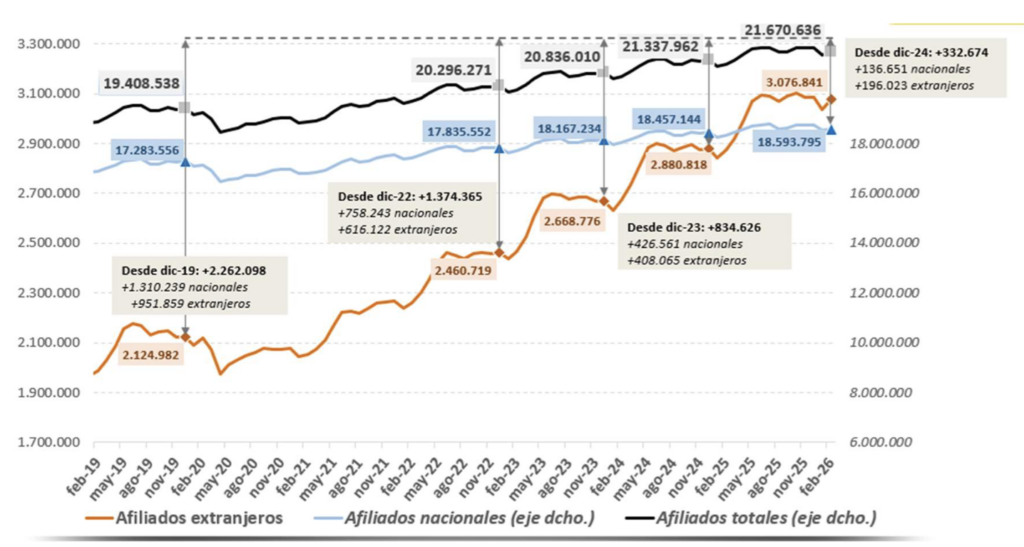
This increase coincides with a period of strong momentum in the Spanish labor market. A significant share of the jobs created in recent years has been filled by workers from other countries, highlighting how immigration has become a key factor in sustaining employment growth.
Today, foreign workers represent more than 14% of all Social Security contributors, a proportion that continues to increase year after year.
⏺️ Strong growth among workers from Latin America
The profile of foreign workers in Spain is becoming increasingly diverse. Although around three out of every ten foreign affiliates come from European Union countries, the most notable growth is occurring among workers from Latin America.
In particular, the number of workers from Venezuela, Colombia, and Peru has increased significantly in recent years. In the case of Venezuela, the growth has been especially remarkable: the number of Venezuelan workers affiliated with the Social Security system has multiplied ninefold over the past decade.
At the same time, some communities with a long-standing presence in the Spanish labor market continue to maintain high numbers. This is the case for workers from Morocco and Romania, which remain two of the nationalities with the largest number of affiliates.
This scenario reflects an increasingly globalized labor market, where Spain continues to consolidate its position as an attractive destination for workers from many different backgrounds.
⏺️ Sectors with the highest presence of foreign workers
Foreign workers play a particularly important role in several sectors of the Spanish economy.
Within the General Social Security Regime, their presence is especially significant in activities such as:
- Hospitality: 28.9% of workers
- Agriculture: 26.8%
- Construction: 24%
- Transportation: 17.7%
- Administrative services: 17.4%
Their participation is even higher in certain special Social Security systems:
- Household employment system: 42.4%
- Agricultural system: 37.9%
These figures highlight the essential contribution of foreign workers to several strategic sectors of the Spanish economy.
⏺️ Growth in foreign entrepreneurship and highly skilled self-employed professionals
In addition to employment as salaried workers, the growing presence of foreign nationals can also be seen in the field of entrepreneurship.
The number of foreign self-employed workers now exceeds half a million, and their growth rate is significantly higher than that of the self-employment sector overall in Spain.
What is particularly noteworthy is that an increasing number of international entrepreneurs are launching businesses in highly skilled sectors, especially in areas related to technology, the digital economy, and content creation.
This reflects a growing trend: Spain is not only attracting labor, but also international talent and entrepreneurial projects driven by foreign professionals.
💡 At ARC Legal Abogados, we provide comprehensive legal advice to foreign workers, freelancers, and entrepreneurs who wish to legally enter the Spanish labor market or start their own business activity.
Our services include:
– Residence and work permits for employees
– Authorizations for highly qualified professionals and executives
– Assistance with self-employment registration and residence permits for self-employed professionals
– Visas and authorizations for researchers, scientists, and technical personnel
– Legal assistance with company formation and corporate structures
⏺️ Immigration as a driver of the Spanish labor market
Current figures show that the growth of foreign employment is not a temporary phenomenon, but rather a structural trend within the Spanish labor market.
Factors such as population aging, the internationalization of the economy, and the growing demand for specialized talent suggest that the presence of foreign workers will continue to increase in the coming years.
In this context, immigration policies and residence and work authorization procedures play an increasingly important role in facilitating the integration of international workers and enabling companies to access the talent they need.
⏺️ How ARC Legal Abogados can assist you
At ARC Legal, we advise foreign workers, highly qualified professionals, entrepreneurs, and companies seeking to hire international talent in Spain.
Our firm provides legal assistance in procedures related to:
- Residence and work authorizations
- Visas for highly qualified professionals
- Residence permits for entrepreneurs and digital nomads
If you are considering working, investing, or starting a business in Spain, our firm can help analyze your situation and plan the most appropriate immigration strategy.
Related publications
- Residence authorization for job seeking or starting a business project | 2026 Guide
- Residence authorization with work permit exemption | 2026 Guide
- Authorization of Stay for Training Activities in Spain | 2026 Guide
Prefer to read this article in Spanish 🇪🇸? You can find it here: Más de 3 millones de trabajadores extranjeros cotizan en España en febrero de 2026
The information provided in this article is for informational purposes only and does not constitute legal advice. While we strive to provide accurate and up-to-date information, immigration regulations may change and may be interpreted differently by the relevant authorities. For personalized and updated legal advice, we recommend consulting with a specialized immigration lawyer.