

The latest data published by Eurostat confirms a clear trend in international protection across the European Union: fewer asylum applications, but more decisions being issued by authorities. This shift is not only visible in the short term (monthly data), but is also confirmed when looking at the full year 2025, pointing to a structural evolution of the European asylum system.
⏺️ Decline in asylum applications: a trend consolidating in 2025
In December 2025, 47,650 first-time asylum applications were registered in the EU, confirming the downward trend observed in recent months. However, the most relevant figure is the annual one: in 2025, a total of 669,400 first-time applications were submitted, representing a 27% decrease compared to 2024 (912,400).
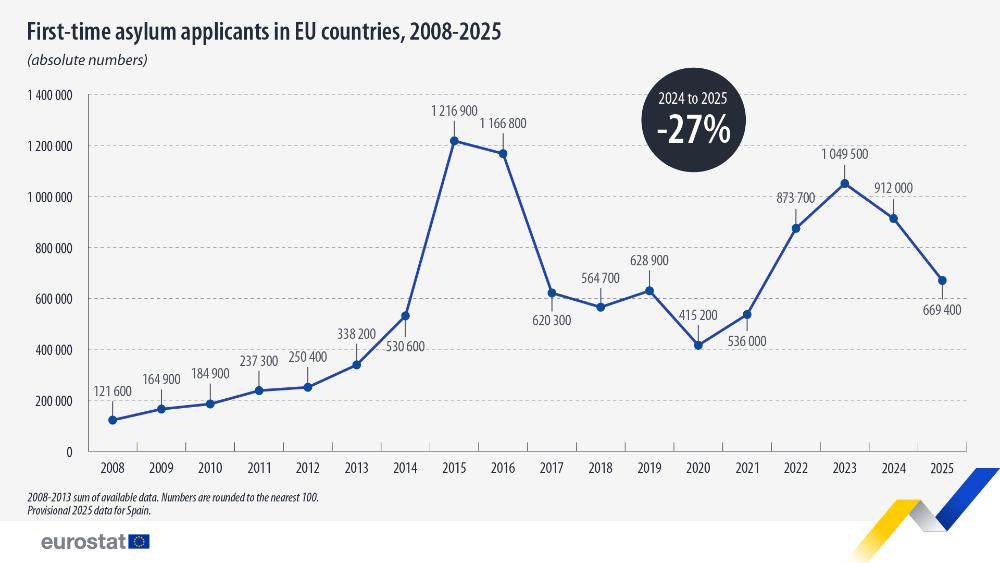
This decline is particularly significant when analyzed in context. After several years of sustained pressure on the European asylum system, 2025 marks a turning point toward a more consistent reduction in applications.
Several factors may explain this trend:
- Changes in migration routes
- Geopolitical developments in countries of origin
- Control measures and cooperation with third countries
- Indirect effects of the upcoming Migration and Asylum Pact
However, this decrease does not necessarily indicate a reduced need for international protection. Rather, it reflects a transformation in the context in which applications are being made.
At the same time, subsequent applications (9,255 in December) show a notable year-on-year increase, pointing to a growing use of legal mechanisms following an initial refusal.
⏺️ Main nationalities: shifting dynamics and evolving applicant profiles
The 2025 data reveals a significant shift in the composition of asylum seekers. Not only is the volume changing, but also the profile of applicants.
For the first time in over a decade, Venezuela has become the leading country of origin, with 89,500 applications (13% of the total). It is followed by Afghanistan (63,800, 10%) and Syria (40,000, 6%), which had consistently led asylum applications from 2013 to 2024.
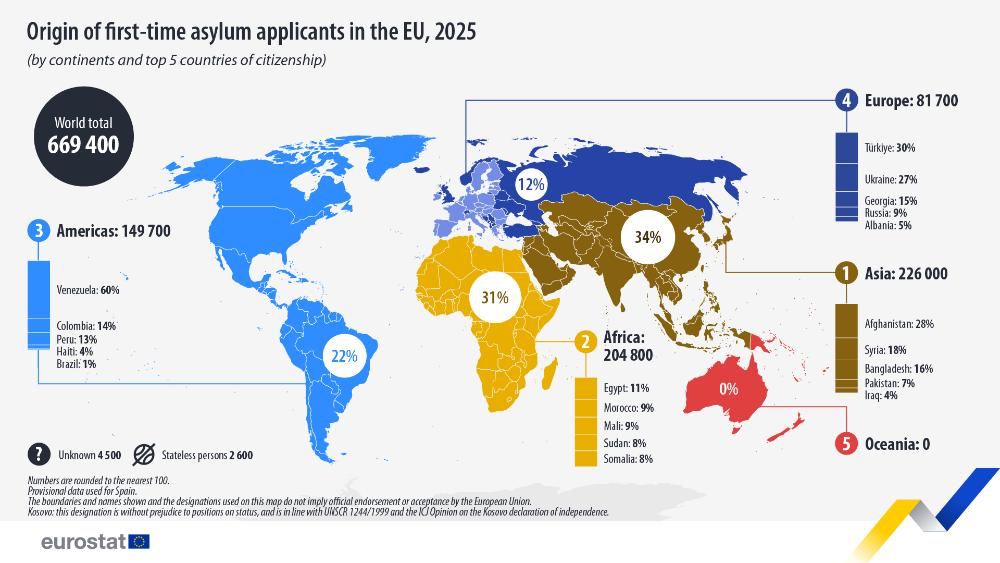
This change goes beyond statistics. It represents a fundamental transformation in the nature of asylum cases.
Traditionally, the European asylum system has been largely shaped by claims linked to armed conflicts (such as Syria). However, the growing weight of countries like Venezuela introduces more complex legal scenarios, where:
- Persecution is not always individualized or easily evidenced
- Claims may be based on institutional collapse, economic crisis, or widespread human rights violations
- The line between economic migration and international protection becomes more blurred in practice
This forces both authorities and legal practitioners to refine their analytical criteria and strengthen the legal narrative of each case.
Moreover, the coexistence of very different applicant profiles — from individuals fleeing armed conflict to those facing structural instability — is creating a more heterogeneous system, where standardized approaches are increasingly difficult to apply.
In this context, case preparation becomes critical. It is no longer sufficient to rely on general country conditions; a solid, coherent, and well-documented legal narrative tailored to each Member State’s interpretation criteria is essential.
⏺️ Spain at the center of the European asylum system
Spain not only remains one of the main destination countries, but in 2025 it leads the EU in total asylum applications.
With 141,000 applications (21% of the EU total), Spain ranks ahead of:
- Italy (19%)
- France (17%)
- Germany (17%)
- Greece (8%)
Together, these five countries account for 83% of all asylum applications in the European Union.
This confirms Spain’s central role within the system, both in absolute terms and relative pressure. On a per capita basis, Spain records 2.9 applications per 1,000 inhabitants, placing it among the highest in the EU, only behind Greece and on par with Cyprus.
From a practical perspective, this has direct implications:
- Increased administrative workload for asylum offices
- Potential impact on processing times
- Greater need for strategic planning by applicants and their legal representatives
⏺️ Unaccompanied minors: a persistent structural challenge
The situation of unaccompanied minors remains one of the most sensitive aspects of the European asylum system.
In 2025, 21,125 applications were submitted by unaccompanied minors, confirming the structural nature of this phenomenon.
The main nationalities were:
- Afghanistan (13%)
- Eritrea (11%)
- Syria (11%)
- Egypt (11%)
- Somalia (11%)
Spain is among the leading receiving countries, with 3,210 applications, only behind Germany and the Netherlands.
From a legal standpoint, these cases require enhanced protection and a tailored approach, where the best interests of the child must guide the entire procedure.
Additionally, handling these cases involves complex coordination between child protection systems and immigration authorities.
⏺️ More decisions and higher recognition rates: a more responsive system
While applications are decreasing, decision-making capacity is increasing.
In the fourth quarter of 2025, 229,735 first-instance decisions were issued, showing a significant increase compared to previous periods. Of these, 45% were positive.
This increase in decision-making activity aligns with the broader annual trend: the European asylum system appears to be gradually reducing its backlog, although structural pressure remains high in many Member States.
From a practical standpoint, this may lead to:
- Faster procedures in certain profiles
- Greater predictability in some types of applications
- The need to prepare stronger, more robust cases from the outset
⏺️ How can ARC Legal Abogados assist you?
The asylum procedure is not straightforward. Each case is different and requires a clear analysis from the outset to avoid mistakes that may affect the outcome.
At ARC Legal Abogados, we support you throughout the entire process, with a practical approach tailored to your specific situation:
- We assess your case to determine whether asylum is the most suitable option
- We assist you in preparing the application and supporting documentation
- We structure your file in a clear and consistent way
- We monitor the progress of your case
- In the event of a refusal, we evaluate the next steps
In addition, if asylum is not the most appropriate route, we will explore alternative options within the Spanish immigration system with you.
Our goal is to ensure you have clarity at every stage and a well-defined strategy from the very beginning.
Related posts
- The European Union publishes two key new Regulations on asylum
- More than 4.3 million Ukrainians maintain temporary protection status in the European Union at the end of 2025
- Extraordinary regularization 2026: the Government publishes a second draft with relevant changes
¿Prefieres leer este artículo en español 🇪🇸? Aquí te dejamos el enlace: Asilo en la Unión Europea: caída de solicitudes y aumento de decisiones en el cierre de 2025
The information provided in this article is for general informational purposes only and does not constitute legal advice. While we strive to ensure accuracy and keep the content up to date, immigration laws and regulations are subject to change and interpretation by the competent authorities. For tailored and up-to-date legal advice, we recommend consulting with a qualified immigration lawyer.