

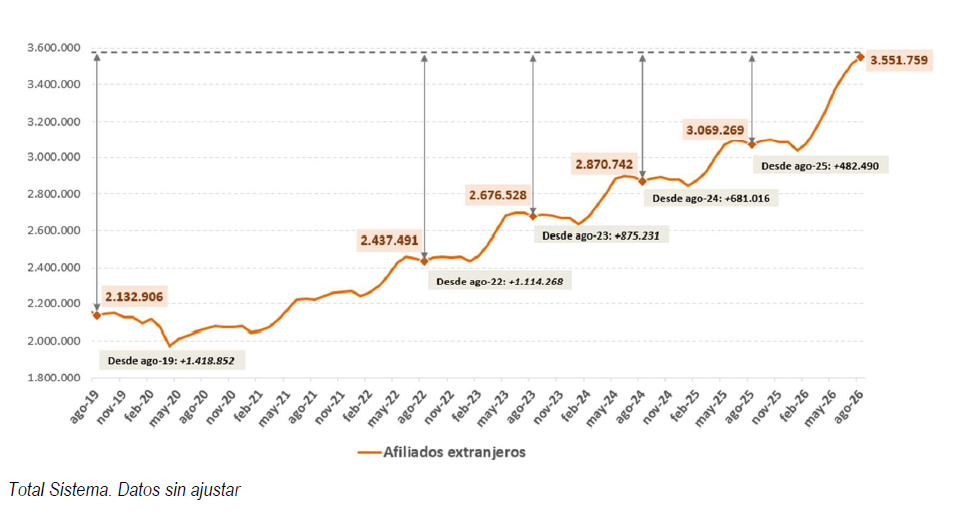
The average number of foreign workers affiliated with Spain’s Social Security system reached 3,551,759 in August 2026, representing an increase of 39,535 compared with the previous month and 482,490 compared with August 2025.
Foreign affiliation therefore grew by 15.72% year over year, compared with 3.1% growth across the Social Security system as a whole. After adjusting for seasonal and calendar effects, the figure reached 3,526,093 foreign workers, the highest level in the series.
According to data published by the Spanish Ministry of Inclusion, Social Security and Migration, the number of foreign workers affiliated with Social Security has increased by more than 1.2 million since June 2022. In addition, foreign workers account for 50.9% of the employment created since the labor reform came into force.
⏺️ The impact of the extraordinary regularization process
Foreign Social Security affiliation has grown particularly strongly in recent months. This acceleration coincides with the launch of the extraordinary administrative regularization process for foreign nationals.
As of August 31, 337,917 foreign nationals who had obtained regularization through this process were registered with the Spanish Social Security system.
Of these:
- 269,627 people, or 79.8%, were registered under the General Social Security Scheme.
- 16,912 people, approximately 5%, were self-employed.
- 203,418 were men, representing 60.2%.
- 134,499 were women, representing 39.8%.
By nationality, Colombian and Venezuelan nationals accounted for the highest number of registrations linked to the regularization process, with 97,376 and 66,733 affiliated workers respectively.
These figures reflect one of the main practical effects of the extraordinary regularization process: the incorporation into the formal labor market of people who, after obtaining the relevant authorization and completing the required procedures, can access employment and make Social Security contributions legally in Spain.
⏺️ Moroccan, Colombian and Romanian nationals among the largest groups
Of the 3,551,759 foreign workers affiliated on average in August, 2,030,849 were men and 1,520,910 were women. Women now account for almost 43% of all foreign workers affiliated with Social Security.
Approximately 27% of affiliated workers were nationals of European Union countries.
The main nationalities by number of affiliated workers were:
- Morocco: 407,350 affiliated workers.
- Colombia: 368,901.
- Romania: 336,681.
- Venezuela: 248,550.
- Italy: 222,158.
- Peru: 140,467.
- China: 137,872.
- Ukraine: 84,564.
⏺️ Sectors with the highest presence of foreign workers
Foreign workers have a particularly significant presence in certain sectors of activity.
Although they represent 15.9% of all affiliated workers, their proportion is considerably higher in certain sectors of the General Social Security Scheme:
- Hospitality: 33.6% of affiliated workers.
- Agriculture: 28.1%.
- Construction: 27%.
- Administrative activities: 20.2%.
- Transportation: 18.5%.
Foreign workers also have a particularly strong presence in the special Social Security schemes. They represent 47.6% of people registered under the Special Scheme for Household Employees and 39.2% of those registered under the Special Agricultural Scheme.
⏺️ More than 537,000 foreign self-employed workers
The number of foreign self-employed workers also continues to grow. In August 2026, it reached 537,660 affiliated workers, representing an increase of 10.3% compared with the previous year.
Foreign self-employment is not limited to sectors traditionally associated with migrant employment. There is also a significant foreign presence in highly qualified activities, such as telecommunications and computer programming, where foreign workers represent 33.5% of all workers registered in this area.
Foreign workers also have a significant presence in:
- Household activities: 26.4%.
- Hospitality: 25.7%.
- Administrative activities: 19.8%.
- Construction: 19%.
- Real estate activities: 18.5%.
💡 At ARC Legal Abogados, we provide comprehensive legal advice to foreign workers, self-employed professionals and entrepreneurs who wish to enter the Spanish labor market legally or start a self-employed activity.
Our services include:
– Residence and work permits for employees.
– Authorizations for highly qualified professionals and executives
– Self-employed registrations and residence authorizations for self-employment.
– Visas and authorizations for researchers, scientists and technical professionals.
– Advice on incorporating companies and establishing business entities.
⏺️ The importance of a residence and work authorization
Registration with the Spanish Social Security system is one of the main consequences of being authorized to reside and work legally in Spain. Depending on each person’s circumstances, there may be different routes to access the Spanish labor market, including a residence and work authorization as an employee, a self-employed residence authorization, arraigo residence permits, the extraordinary regularization process or certain authorizations linked to international mobility, such as the digital nomad visa or the authorization for highly qualified professionals.
However, each authorization has different requirements, limitations and legal effects. The right to work, the type of activity permitted, the obligation to register with Social Security and the conditions for renewing or modifying the authorization must be assessed according to each person’s specific immigration status.
⏺️ How ARC Legal can help you
At ARC Legal, we advise foreign nationals, self-employed professionals and companies on the planning and processing of residence and work authorizations in Spain.
We can help you to:
- Assess the most suitable residence route for your circumstances.
- Prepare employee residence and work authorizations.
- Evaluate self-employment and business projects.
- Review the legal consequences of an extraordinary regularization process.
- Process renewals and modifications of residence authorizations.
- Coordinate the necessary employment, administrative and immigration documentation.
If you need to assess your situation or would like to know which authorization allows you to work legally in Spain, you can contact our firm.
Related publications
- Residence and work authorization as an employee | 2026 Guide
- Self-employed residence and work authorization | 2026 Guide
- Digital nomad visa in Spain | 2026 Guide
Prefer to read this article in Spanish 🇪🇸? You can find it here: La afiliación extranjera supera los 3,5 millones en agosto y alcanza un nuevo máximo histórico
The content of this article is provided for informational purposes only and does not constitute legal advice. Spanish immigration law is subject to ongoing changes in interpretation and administrative practice. At ARC Legal, we make every effort to keep our information up to date and based on official sources, but we always recommend consulting a specialized professional before starting any procedure or making any legal decisions. If you need personalized advice regarding your situation, you can contact our firm.