

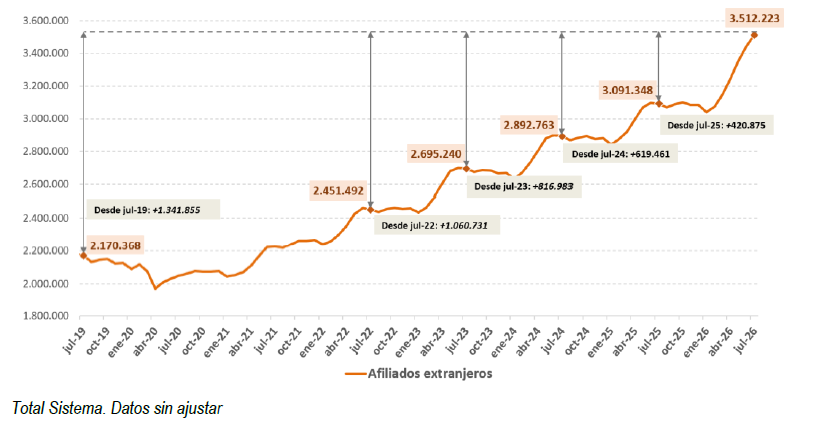
The presence of foreign workers in the Spanish labor market continues to grow, reaching a new all-time high. In July, Spain’s Social Security system registered an average of 3,512,223 foreign contributors, exceeding the 3.5 million mark for the first time.
This represents 66,046 more foreign contributors than in the previous month and 420,875 more than a year ago. On a year-over-year basis, foreign Social Security enrollment increased by 13.6%, well above the 2.9% growth recorded across the system as a whole.
The figures confirm not only the growing importance of foreign nationals in the Spanish labor market, but also the increasing diversification of their participation: employment, self-employment, sectors traditionally associated with foreign labor, and, increasingly, professional and technology-related activities requiring higher qualifications.
⏺️ More than 3.4 million foreign workers on a seasonally adjusted basis
The upward trend remains clear after seasonal and calendar effects are removed. On a seasonally adjusted basis, Spain now has 3,407,558 foreign workers registered with Social Security.
Over the last twelve months, 408,333 foreign workers have been added under this measurement.
The medium-term trend is particularly significant. Since June 2022, the number of workers from other countries has increased by more than 1.2 million.
Furthermore, foreign workers account for 46.3% of the employment created since the labor reform came into effect. In other words, almost one in every two new Social Security contributors added during this period is a foreign national.
⏺️ The impact of the extraordinary regularization process is beginning to be reflected in Social Security enrollment
One of the most significant aspects of the July figures is the evolution of Social Security enrollment associated with the extraordinary regularization process carried out in 2026.
During the first seven months of the year, the incorporation of foreign workers into the Social Security system has been particularly dynamic, with growth accelerating from late April, coinciding with the launch of the process.
As of July 30, 262,475 foreign nationals were already registered with Social Security as a result of the regularization process.
This figure provides an initial indication of one of the main practical effects of the procedure: enabling thousands of people who were already living in Spain to transition to an immigration status that allows them to participate formally in the labor market.
Among those registered with Social Security as a result of the process:
- 213,883, or 81.5%, were registered under the General Social Security Scheme.
- 12,675, or 4.8%, were registered as self-employed workers.
- 158,171 were men, representing 60.3%.
- 104,304 were women, representing 39.7%.
These initial figures will be particularly relevant over the coming months when assessing the actual impact of the regularization process from both an immigration and labor market perspective.
⏺️ Where do foreign workers come from?
Of the 3,512,223 foreign workers registered with Social Security on average in July, 2,010,267 are men and 1,501,956 are women. Women now represent close to 43% of all foreign workers registered with Social Security.
In terms of origin, approximately 27.5% of foreign contributors are nationals of other European Union countries, while the majority come from non-EU countries.
Morocco remains the leading country of nationality among foreign workers registered with Social Security in Spain, with 415,310 contributors. It is followed by Colombia, with 347,467; Romania, with 342,555; Venezuela, with 247,209; Italy, with 223,589; China, with 136,395; Peru, with 133,002; and Ukraine, with 84,599.
These figures also illustrate how the origin of labor migration to Spain has evolved in recent years, with Latin American countries accounting for an increasingly significant share.
⏺️ One in three hospitality workers is a foreign national
Foreign workers currently represent 15.6% of all workers registered with Social Security, although their share is considerably higher in certain sectors.
Under the General Social Security Scheme, foreign nationals account for 32.9% of workers in Hospitality, 28% in Agriculture, and 26.6% in Construction.
Their presence is also significant in Administrative Activities, where they represent 19.5% of workers, and Transportation, at 18.4%.
Their share is even higher under certain special Social Security schemes. Foreign workers represent 46.7% of those registered under the Special Scheme for Household Employees and 39.2% under the Special Agricultural Scheme.
These figures demonstrate the extent to which certain sectors of the Spanish economy currently depend on the incorporation of workers from other countries.
⏺️ 86.4% have permanent employment contracts
The increase in foreign Social Security enrollment has also been accompanied by a significant change in the type of employment contracts held by foreign workers.
Currently, 86.4% of foreign employees have permanent employment contracts.
This development is particularly significant when compared with the period between 2017 and 2021, before the labor reform, when the average proportion of permanent contracts among foreign workers stood at 58.9%.
As a result, the temporary employment rate among foreign workers has fallen to 13.6%, almost in line with the 13.4% recorded among Spanish workers.
The growth in foreign employment is therefore not limited to the number of people registered with Social Security. It is also taking place within a labor market in which permanent employment has become considerably more prevalent than it was only a few years ago.
⏺️ More than 531,000 foreign nationals are self-employed in Spain
Another particularly relevant indicator is the continued growth in self-employment.
Spain now has 531,568 foreign self-employed workers, representing an increase of 9.2% compared with a year ago.
Their presence is also no longer concentrated exclusively in sectors traditionally associated with foreign entrepreneurship.
In Telecommunications and Computer Programming, foreign nationals now represent more than 33% of self-employed workers registered in these activities. In other words, approximately one in every three self-employed professionals in this sector is a foreign national.
Foreign self-employed workers also have a significant presence in Household Activities (27.4%), Hospitality (25.6%), Administrative Activities (19.3%), Construction (18.6%), and Real Estate Activities (18.4%).
This trend points to an increasingly diverse profile of labor migration in Spain, in which entrepreneurship, professional activities, and sectors linked to the digital economy are gaining importance alongside traditional employment.
💡 At ARC Legal Abogados, we provide comprehensive legal assistance to foreign employees, self-employed professionals, and entrepreneurs seeking to enter the Spanish labor market legally or start their own business activities in Spain.
Our services include:
– Residence and work permits for employees.
– Residence permits for highly qualified professionals and executives.
– Self-employment residence and work permits and assistance with self-employment registration.
– Visas and residence permits for researchers, scientists, and technical professionals.
– Legal assistance with setting up companies and other business entities in Spain.
⏺️ How ARC Legal Abogados can help
The contribution of foreign workers to the Spanish economy is not only quantitative. Foreign nationals are also playing an increasingly important role in strategic, highly qualified, and innovative sectors.
At ARC Legal, we assist both companies seeking to attract international talent and foreign workers who wish to obtain or regularize their immigration status in Spain.
Contact our firm and we will assist you with your immigration procedures in a legally compliant, secure, and personalized manner.
Related articles
- SEPE publishes the Third-Quarter 2026 Shortage Occupation List with no significant changes from the beginning of the year
- Government measures to speed up Extraordinary Regularization applications
- Can I apply for a Digital Nomad Residence Permit if I am in Spain as a student?
Prefer to read this article in Spanish 🇪🇸? You can find it here: La Seguridad Social supera por primera vez los 3,5 millones de trabajadores extranjeros afiliados
The content of this article is provided for informational purposes only and does not constitute legal advice. Spanish immigration regulations are subject to ongoing legislative, administrative, and interpretative changes. At ARC Legal, we make every effort to keep our information up to date and verified against official sources. However, we always recommend consulting a specialized professional before starting any procedure or making legal decisions. If you need personalized advice regarding your situation, please contact our firm.