


In 2024, the Member States of the European Union issued 3.5 million first residence permits to non-EU citizens, representing an 8.3% decrease (-315,700 permits) compared with 2023, the year that marked the highest figure ever recorded (3.8 million).
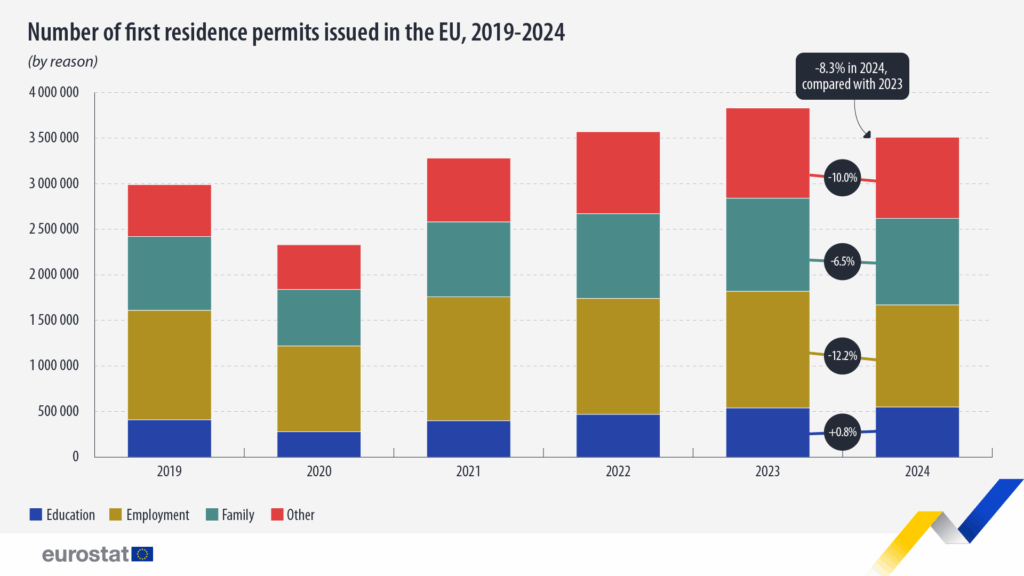
According to the latest Eurostat data, this drop is mainly explained by the lower number of permits issued for employment, family, and other reasons. Education was the only category to experience a slight increase.
⏺️ Main reasons for residence permits
The reason for granting a residence permit is a key indicator of migration dynamics and the EU’s attractiveness in areas such as the labor market, higher education, family reunification, or protection needs.
Employment-related permits remained the leading category in 2024, with 1.1 million permits (31.9% of the total). However, it was also the category that fell the most compared with 2023, with a 12.2% decrease (-155,500 permits). This reduction reflects a European context of economic slowdown and stricter policies on hiring non-EU workers in certain sectors.
The second most significant category was family-related permits, which amounted to 950,600 (27.1% of the total). This represented a 6.5% decline (-65,800) compared with 2023, pointing to a slight contraction in family reunification processes, though this remains a cornerstone of EU migration policy, especially in countries with large settled communities.
Permits granted for other reasons, including international protection and other residence types, reached 886,300 (25.3%), showing a 10.0% decrease (-98,900). This category highlights the vulnerability of migration flows linked to political instability and humanitarian crises.
By contrast, education-related permits were the only category to increase, with 549,400 permits (15.7% of the total), reflecting a 0.8% rise (+4,500). This growth confirms that Europe continues to be an attractive destination for international students, consolidating academic mobility as a safe and regulated entry channel.
⏺️ Country trends
Spain topped the list with 561,640 first residence permits (16.0% of the EU total), followed by Germany (544,987; 15.5%), Poland (488,846; 13.9%), Italy (346,411; 9.9%), and France (342,208; 9.8%). Together, these five countries accounted for 65.1% of all permits issued in 2024, confirming their role as the EU’s main entry points.
The sharpest relative declines were registered in Estonia (-42.5%), Malta (-29.8%), and Poland (-23.9%), while the most significant increases were recorded in Greece (+24.0%) and Cyprus (+16.1%). These variations reflect both shifts in migration demand and adjustments in national permit-issuing systems.
⏺️ Trends by citizenship
Ukraine remained the top nationality in 2024, with 295,600 permits (8.4% of the total). It was followed by India (192,400) and Morocco (188,400), consolidating their roles as key countries of origin for migration to Europe.
By reason, employment predominated among Ukrainians (72.5%), Belarusians (55.2%), and Indians (43.9%). Family reasons were the main driver for Moroccans (46.6%), Colombians (44.8%), and Turks (35.4%), reflecting historical and linguistic ties with host countries such as Spain, France, and Germany.
Education was the leading reason for Chinese citizens (34.1%), underlining the attractiveness of European universities, while other reasons, particularly international protection, accounted for most permits granted to Afghans (85.4%), Syrians (79.0%), and Bangladeshis (40.8%).
⏺️ Conclusion
The decline in employment-related permits in 2024 reflects both economic pressures and adjustments to national migration policies, while family reunification and education remain stable drivers of legal migration to Europe. The approval of the EU Pact on Migration and Asylum in 2024 will provide a new framework for managing these flows, aiming to strengthen solidarity among Member States and ensure legal certainty for migrants.
At ARC Legal Abogados, we analyze each regulatory and statistical development to provide our clients with safe and up-to-date guidance. If you want to know how these trends may affect your case, contact us for a personalized consultation.
Related publications
- Asylum applications in the European Union: statistics for May 2025
- EU Entry/Exit System (EES) to launch on 12 October 2025
- The ordeal of securing an immigration appointment in Spain: a collapsed system and a thriving black market
Prefer to read this article in Spanish 🇪🇸? You can read it here: Menos permisos de residencia iniciales en la UE en 2024: autorizaciones de trabajo en retroceso, permisos para estudiar al alza
The information contained in this article is for general informational purposes only and does not constitute legal advice. For an assessment tailored to your individual circumstances, we recommend contacting a specialised immigration lawyer.