

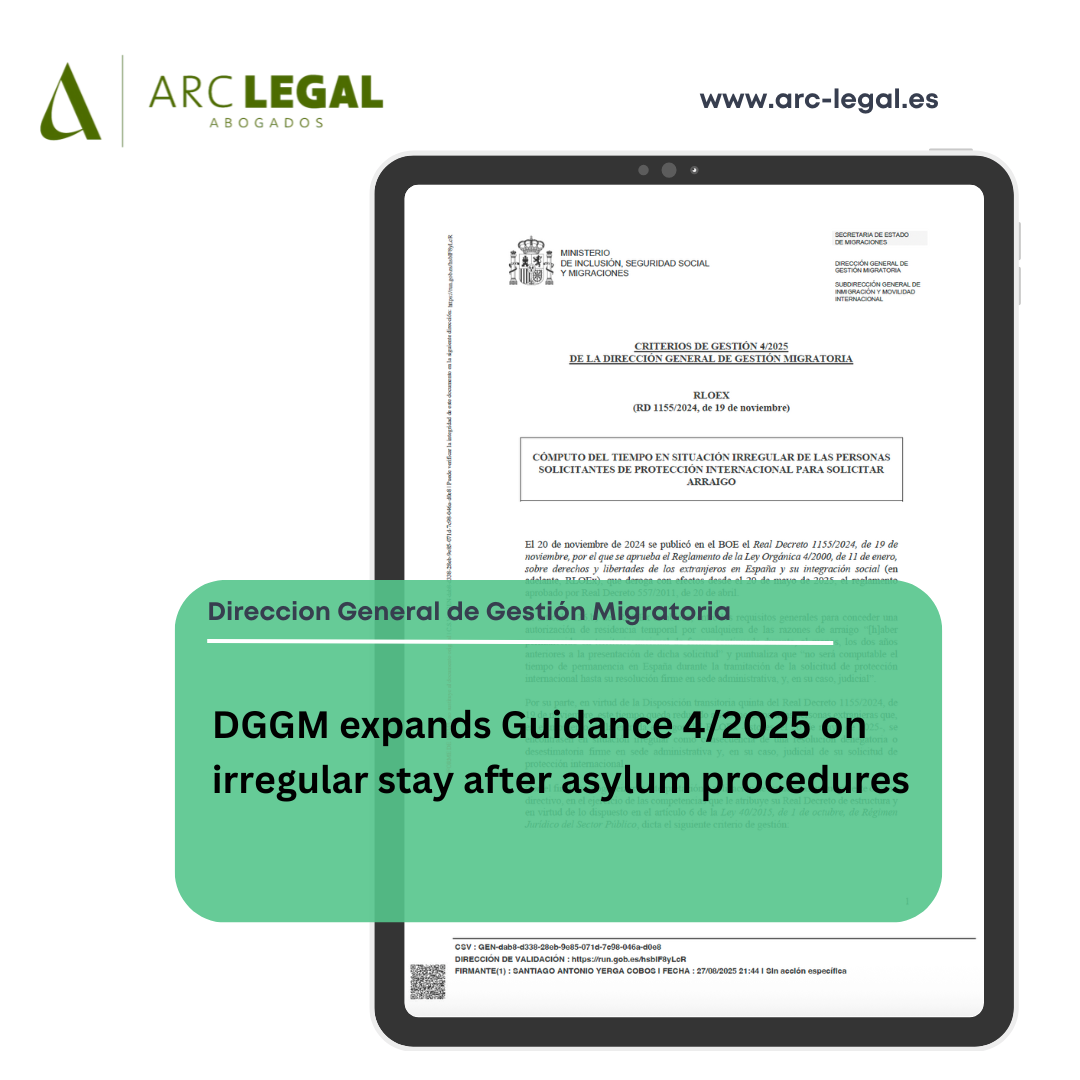
On 27 August 2025, the Dirección General de Gestión Migratoria (Directorate-General for Migration Management) (DGGM) published the Management Guidance 4/2025, clarifying when the period of irregular stay begins to count for asylum seekers wishing to apply for a residence permit based on extraordinary circumstances (“arraigo”). Barely two weeks later, on 12 September 2025, the DGGM issued an expanded version of the same guidance, introducing key clarifications that directly affect thousands of foreign nationals in Spain.
💡 At ARC Legal we maintain a dynamic resource where we constantly update all guidance documents, clarifying notes, and instructions related to the new Immigration Regulation. You can access it here (in Spanish): Reglamento de Extranjería Hub.
⏺️ The general rule: two years
The Immigration Regulation (RD 1155/2024) requires at least two years of continuous residence in Spain in order to apply for arraigo. This period does not include the time during which a person is processing an asylum application. In other words, while the asylum case is pending, no time counts towards the required two years.
⏺️ Key scenarios under the updated guidance
The updated guidance develops in more detail the circumstances in which a person is deemed to be in an irregular situation:
- Rejection, inadmissibility, or closure without appeal: the period starts on the date of the decision, provided no administrative or judicial appeal has been lodged.
- With appeal: the period begins once the decision on the appeal is final and negative.
- Withdrawal of appeal: the period starts from the date the withdrawal is officially recorded.
A significant innovation is the introduction of a pro persona principle: time will be counted from the date most favourable to the applicant, whether that is the date of the decision or the date of its notification.
You can access the updated DGGM Management Guidance 4/2025 here:
⏺️ Transitional provision: six months in earlier cases
The exception in the Fifth Transitional Provision of the new Immigration Regulation (RD 1155/2024) remains in force. Those who were already in an irregular situation on 19 May 2025 can apply for arraigo after just six months of irregular stay.
However, the updated guidance clarifies that this shorter six-month period does not apply to withdrawals. It is reserved only for cases with a firm negative or dismissive decision, either at the administrative or judicial level.
⏺️ What happens if the asylum application is withdrawn?
The updated guidance introduces an important clarification regarding the withdrawal of the asylum application. According to the DGGM:
- The person is considered to be in an irregular situation from the date the withdrawal is officially registered with the competent authority.
- For the purposes of calculating eligibility for arraigo, that date marks the start of the irregular stay period.
- Withdrawal does not allow access to the six-month exception under the Transitional Provision. That exception applies only to firm negative or dismissive decisions.
In practice, this means that a person who has withdrawn their asylum application will need to wait the full two-year irregular stay period before applying for arraigo, even if they were already in Spain before the new Regulation entered into force.
⏺️ Legal certainty and limitations in cases of withdrawal
The update of the Management Guidance 4/2025 is a significant step towards legal certainty, as it finally establishes clear and detailed criteria to be followed when calculating irregular stay after an asylum procedure. This clarity resolves an area that was previously interpreted inconsistently.
However, the decision to exclude withdrawals from the Transitional Provision introduces a notable limitation. Those who renounced their asylum proceedings in the hope of accessing regularisation after six months must now wait the full two years.
This raises a broader legal and social debate:
- Should a voluntary withdrawal be treated the same way as a firm rejection?
- To what extent should withdrawal, often motivated by lack of resources or guidance, be excluded from a transitional measure designed to prevent prolonged irregularity?
The new guidance reinforces regulatory coherence but leaves those who withdrew their applications in a weaker position, forced to wait longer before accessing regularisation.
⏺️ Need legal assistance?
At ARC Legal we are specialists in Spanish immigration law. If you have received an asylum rejection and want to explore your options for applying for arraigo, we can advise and support you throughout the process. You can contact us here.
Related publications
- Asylum and Temporary Protection in Spain: August 2025 Statistics
- TIE collection in Madrid update September 5, 2025 | Find out if your Spanish ID card is ready
- The ordeal of securing an immigration appointment in Spain: a collapsed system and a thriving black market
Prefer to read this article in Spanish 🇪🇸? You can read it here: La DGGM amplía el Criterio 4/2025 sobre el cómputo del tiempo irregular tras solicitudes de asilo
The information contained in this article is for general informational purposes only and does not constitute legal advice. For an assessment tailored to your individual circumstances, we recommend contacting a specialised immigration lawyer.