

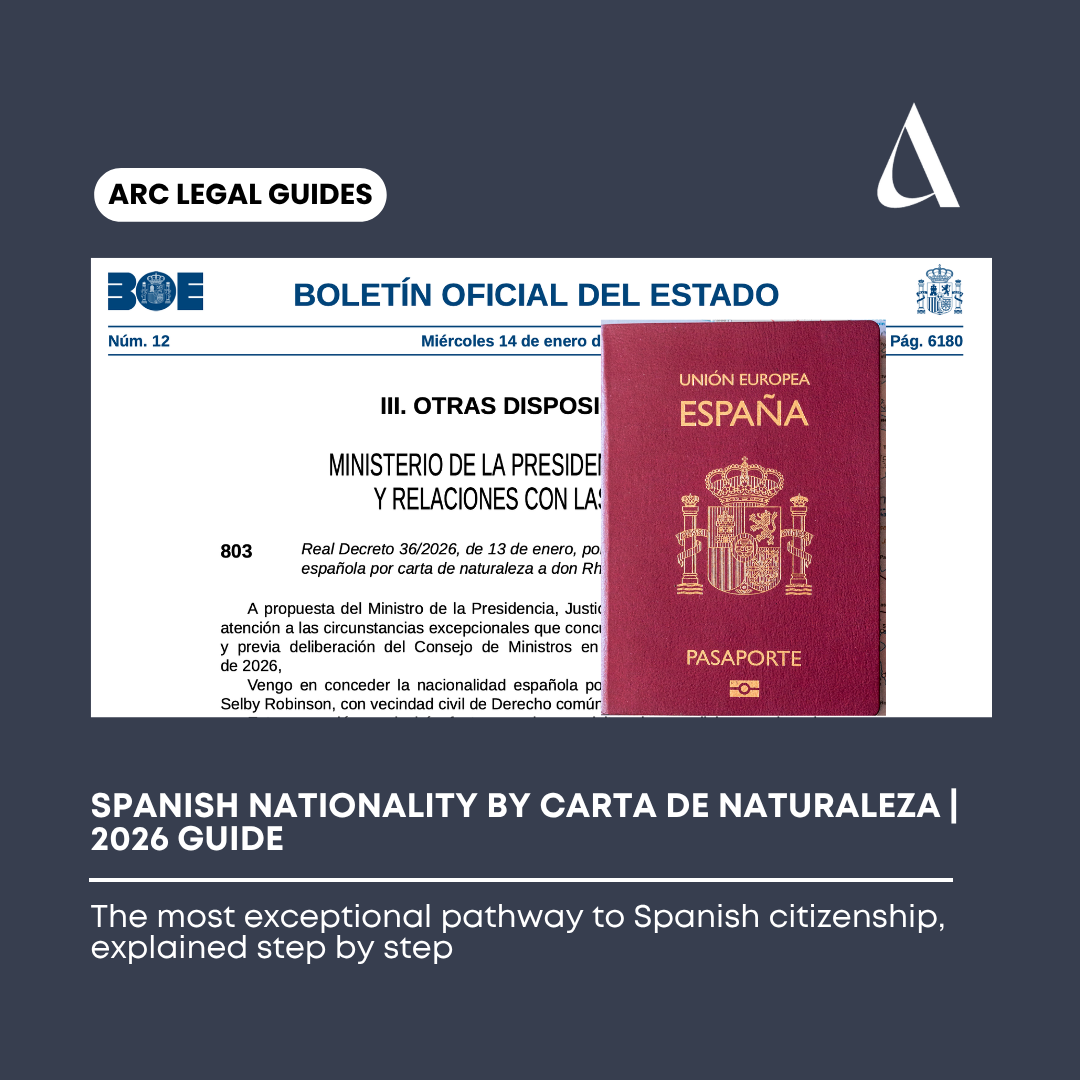
Within the different pathways to obtain Spanish nationality, there is one option that is often overlooked but highly relevant in certain cases: nationality by carta de naturaleza (grant of nationality by the Government through a Royal Decree).
This is an exceptional mechanism that allows individuals to acquire Spanish nationality without meeting the usual residency requirements. However, precisely because of its extraordinary nature, it is not a procedure available to everyone.
In this guide, we explain clearly what nationality by carta de naturaleza is, when it may apply, and how a strong application should be structured.
⏺️ What is Spanish nationality by carta de naturaleza?
Nationality by carta de naturaleza is a form of acquiring Spanish nationality granted directly by the Government through a Royal Decree.
This implies something fundamental: this is not an automatic process, but a discretionary decision.
In practice, this means:
- There is no right to obtain it, even if you apply
- There are no fixed requirements such as years of residence
- Each case is assessed individually
Unlike other procedures, this is not about meeting predefined criteria—it is about convincing the Administration that the case deserves exceptional treatment.
⏺️ The key to the process: understanding what “exceptional” means
One of the most common mistakes we see in practice is trying to fit any profile into this pathway.
The reality is that “exceptional circumstances” are not defined by law because they cannot be standardized. They depend on the context, the applicant’s profile, and, most importantly, how the case is built.
Generally speaking, the following types of situations may be considered:
- Professional careers with significant impact (sports, science, business, culture)
- Individuals with a particularly strong connection to Spain
- Cases with a relevant humanitarian or social component
- Profiles that generate strategic or institutional interest
However, there is one key point: it is not only about what you have done, but how it is explained and evidenced.
The same profile can be approved or rejected depending on how the application is presented.
⏺️ Who can apply?
From a formal standpoint, the following individuals may apply for nationality through this route:
- Adults or emancipated individuals
- Individuals over 14 years old assisted by a legal representative
- Legal representatives of minors under 14
- Individuals with legally modified capacity or their representatives, depending on the case
In practice, what really matters is not who submits the application, but whether the case has a sufficient basis to be considered exceptional.
⏺️ How an application for nationality by carta de naturaleza is actually built
This is where this procedure differs entirely from others. It is not a standard administrative process—it is a legal strategy exercise.
Initial assessment: does it make sense to proceed?
Before starting, it is essential to answer one key question: can this case genuinely be defended as exceptional?
If the answer is not clear, it is often advisable to consider other, more predictable pathways.
The supporting statement: the core of the application
The most important document is not a certificate or a form.
It is the supporting statement.
This document builds the narrative of the case:
- The applicant’s background and trajectory
- Their connection to Spain
- What they contribute—or can contribute—to the country
- Why their case deserves exceptional treatment
In our experience, this document makes the difference between a strong application and one that is not properly considered.
Documentation: consistency over quantity
While there is a set of basic required documents, what truly matters is the overall coherence of the file.
Typically, the following are included:
- Birth certificate duly legalized or apostilled
- Criminal background certificates
- Identification documents (passport)
- Evidence supporting the exceptional nature of the case
- Letters of support or institutional endorsements (when available)
However, beyond the checklist, what matters most is that everything aligns with the narrative of the application.
In addition, the official application form for nationality by carta de naturaleza must be completed.
Submission of the application
The application is addressed to the Ministry of Justice and may be submitted through various administrative channels, either within Spain or abroad via the relevant consulate.
Although the procedure allows some flexibility in terms of submission, this does not reduce the level of rigor required in the content.
Assessment and final decision
Once submitted, the application enters a review phase in which different authorities may be involved.
If the case is considered viable, it is elevated to the Council of Ministers, which makes the final decision.
If approved:
- It is granted through a Royal Decree
- It is published in the Official State Gazette (BOE)
This is the moment when nationality is formally granted.
⏺️ Processing times: what you should know
There is no defined timeline for this procedure.
Unlike other immigration processes, there are no clear reference timeframes. The process can be lengthy and, in many cases, unpredictable.
⏺️ What happens after nationality is granted?
Once nationality has been granted, there are still a few formal steps to complete:
- Oath or pledge before the Civil Registry
- Compliance with legal requirements (loyalty to the Constitution, possible renunciation of previous nationality)
- Registration in the Civil Registry
After this, the individual can apply for a Spanish ID card (DNI) and passport.
💡 If you want to learn more about the oath process, you can read our article:
Have you been granted Spanish nationality? This is how the pre-oath and oath before the Civil Registry work
⏺️ How can ARC Legal help you?
Nationality by carta de naturaleza is not a standard procedure. It requires strategy, legal judgment, and a carefully structured presentation of the case.
At ARC Legal, we approach these cases with a fully personalized strategy.
Our work begins with an honest assessment of your profile. Not every case should be pursued through this route, and our priority is to determine whether there is a solid basis to present it as exceptional.
If the case is viable, we support you throughout the entire process:
- Legal assessment of the exceptional nature of your profile
- Strategic design of the application
- Drafting of the supporting statement with a clear and technical approach
- Identification and collection of key documentation
- Preparation and submission of the application
- Follow-up and management of any requests from the Administration
In these types of procedures, it is not just about submitting documents—it is about building a compelling and coherent case from an institutional perspective.
Our goal is to ensure that your application is well-structured, clear, and aligned with what is truly valued in this type of decision.
If you are unsure whether your profile may fit within this pathway, we can help you assess it and define the best strategy from the outset.
Related publications
- Spanish nationality by residence | 2026 Guide
- Changes in nationality laws: what is happening in Portugal and the lesson for Spain
- Spanish nationality 2025: record applications and over 256,000 pending cases
¿Prefieres leer este artículo en español 🇪🇸? Aquí te dejamos el link: Nacionalidad española por carta de naturaleza | Guía 2026
The content of this article is for informational purposes only and does not constitute legal advice. Immigration and nationality regulations are subject to ongoing changes in interpretation and administrative practice. At ARC Legal, we make every effort to keep our content accurate and up to date based on official sources, but we always recommend consulting a specialized professional before initiating any procedure or making legal decisions. If you need personalized advice, feel free to contact our firm.