

Spain continues to consolidate its position as one of the leading educational destinations for international students. However, the latest official data reveals a more complex landscape, with significant changes in student profiles, countries of origin, trends, and geographic distribution.
Far from being just statistics, this data allows us to anticipate trends, identify opportunities, and better understand how the Spanish immigration system linked to studies works in practice.
⏺️ How many international students are there in Spain?
As of December 31, 2025, the total number of foreign nationals holding a valid student stay authorization in Spain amounts to 85,690 individuals, including both students and their family members.
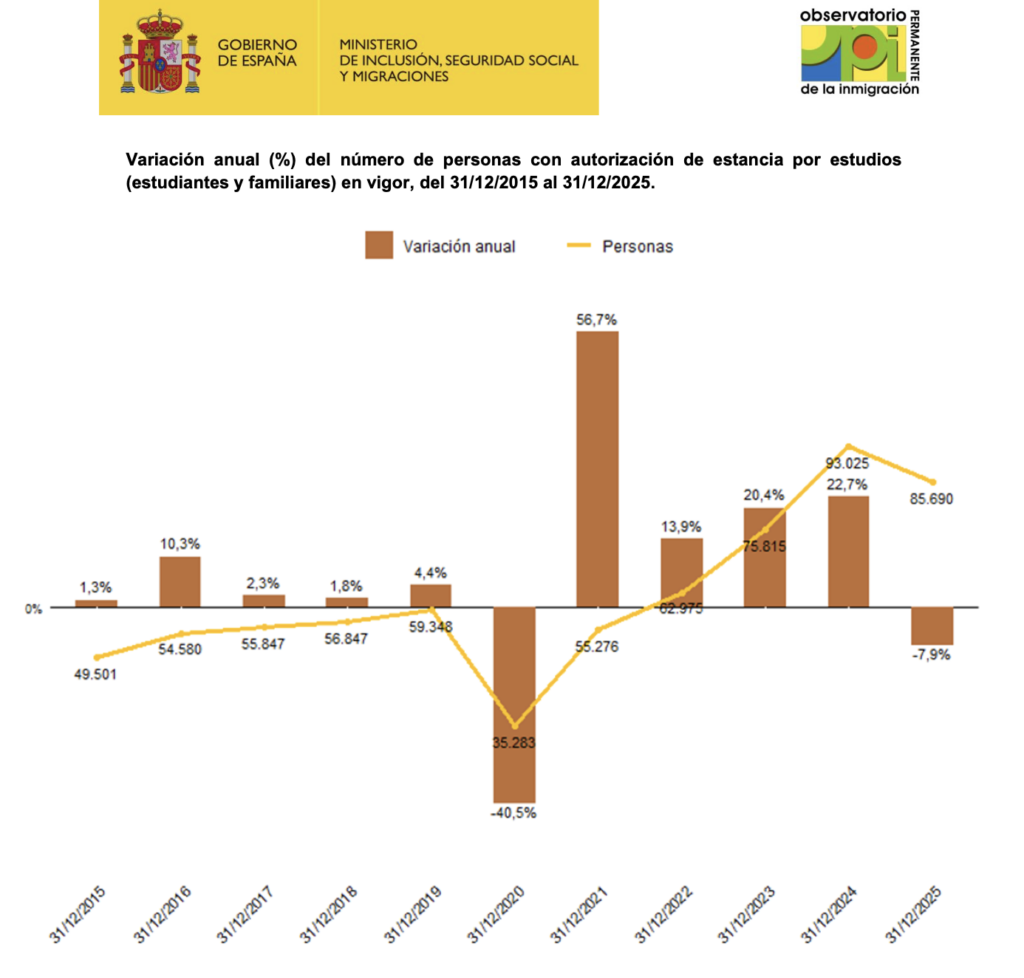
This figure reflects a significant and well-established volume within the Spanish immigration system, especially considering that this is a temporary legal status directly linked to the duration of studies.
Breaking down this number:
- 97% are students
- Only 3% are family members
This distribution highlights that Spain’s international student mobility model is clearly oriented toward individual stays rather than family migration projects. Unlike other residence permits, the student stay authorization is not originally designed as a pathway for family settlement, although in practice it may evolve into one.
⏺️ Where do international students come from?
The nationality breakdown shows a very clear trend: Latin America leads the flow of students to Spain.
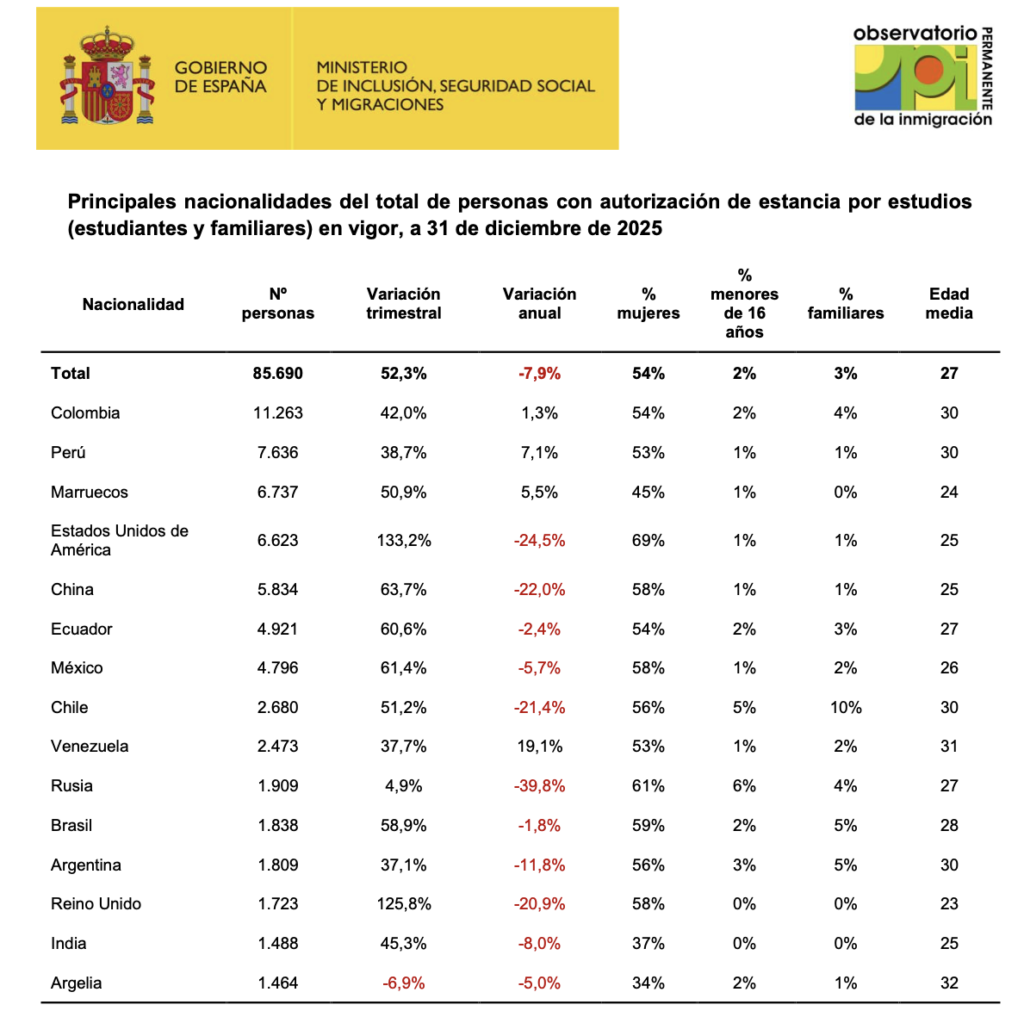
The main nationalities are:
- Colombia (13%)
- Peru (9%)
- Morocco (8%)
- United States (8%)
This predominance is not coincidental. In practice, it responds to several structural factors:
- A shared language, removing one of the main barriers to entry
- Cultural and academic integration
- Legal advantages, such as faster access to Spanish nationality for nationals of Ibero-American countries
- A competitive academic offering, particularly in postgraduate programs
Additionally, the growth of certain nationalities, such as Venezuela (+19.1%), reflects how political and economic contexts in countries of origin directly influence international mobility.
From a professional perspective, this is especially relevant, as it allows us to anticipate client profiles and tailor both legal strategies and communication accordingly.
⏺️ Is the number of students decreasing?
One of the most interesting aspects of the report is that not all markets are evolving in the same way. In fact, there has been a significant decline in several key nationalities:
- Russia: -39.8%
- United States: -24.5%
- China: -22.0%
- United Kingdom: -20.9%
This decline may be linked to multiple factors:
- Geopolitical changes
- Competition from other educational destinations
- Visa or mobility challenges
- Economic conditions
At the same time, growth in other nationalities shows that the system is not declining, but rather transforming.
From a strategic perspective, this suggests that Spain is reshaping its international student profile, with an increasing reliance on emerging markets rather than traditional ones.
⏺️ Where do international students study in Spain?
The geographic distribution is one of the clearest insights from the data:
- Madrid accounts for 31%
- Barcelona for 19%
- Valencia for 11%
This means that more than half of international students are concentrated in just three cities, with Madrid clearly leading.
From a practical standpoint, this concentration has several implications:
- Greater administrative pressure, particularly in immigration offices and police stations
- Increased difficulty in securing appointments, a common issue in practice
- A more developed ecosystem, including universities, advisors, and specialized law firms
At the same time, it creates opportunities in secondary cities, where volumes are lower and processes may be more efficient.
⏺️ Type of studies
The most relevant data point is that 75% of students are enrolled in higher education programs. This confirms that Spain is primarily a destination for:
- Universities
- Master’s degrees
- Specialized programs
Rather than basic or secondary education.
From a legal perspective, this is particularly important because higher education programs allow:
- Access to employment (with limitations)
- The possibility to transition to residence permits
- Greater stability within the immigration system
⏺️ What the data tells us
The data confirms that Spain remains an attractive destination for international students, but within a changing context:
- Growing importance of Latin America
- Decline in traditional markets
- High concentration in major cities
Understanding these trends not only helps interpret the current situation but also anticipate the direction of Spain’s immigration system in the coming years.
⏺️ Do you need assistance with your student stay in Spain?
Starting a student stay process in Spain is not just about meeting requirements — it’s about making the right strategic decisions from the very beginning.
At ARC Legal, we take a clear approach: not only managing your application, but helping you build a solid long-term immigration strategy in Spain.
We support you at every stage of the process:
- Initial feasibility assessment before starting any procedure
- Full preparation of your application in line with current immigration criteria
- Submission and ongoing follow-up
- Assistance with post-approval procedures (TIE card, local registration)
- Planning future scenarios: renewals, transitions to residence, or pathways to Spanish nationality
We understand that every case is different. That is why we work with tailored strategies based on your profile, nationality, and medium- to long-term goals.
If you are considering studying in Spain or have already started the process and want to proceed with legal certainty, you can contact our team.
Related posts
- Legalization and apostille of Spanish diplomas for students who have already returned to their home country
- Residence authorization for job seeking or business projects | 2026 Guide
- Student stay authorization for training activities | 2026 Guide
- International students in Spain | 2026 Guide
¿Prefieres leer el artículo en español 🇪🇸? Aquí puedes: Radiografía de los estudiantes extranjeros en España en 2025
The content of this article is for informational purposes only and does not constitute legal advice. Spanish immigration regulations are subject to ongoing changes in both interpretation and administrative practice. At ARC Legal, we make every effort to keep our content accurate and up to date based on official sources; however, we always recommend consulting a qualified professional before starting any procedure or making legal decisions. If you require personalized advice, please contact our firm.