

The European Union continues to strengthen the enforcement of return decisions affecting third-country nationals who are irregularly present. The latest data for the third quarter of 2025 confirm a trend already observed in previous years: a slight increase in orders to leave, alongside a more significant rise in returns that are effectively carried out.
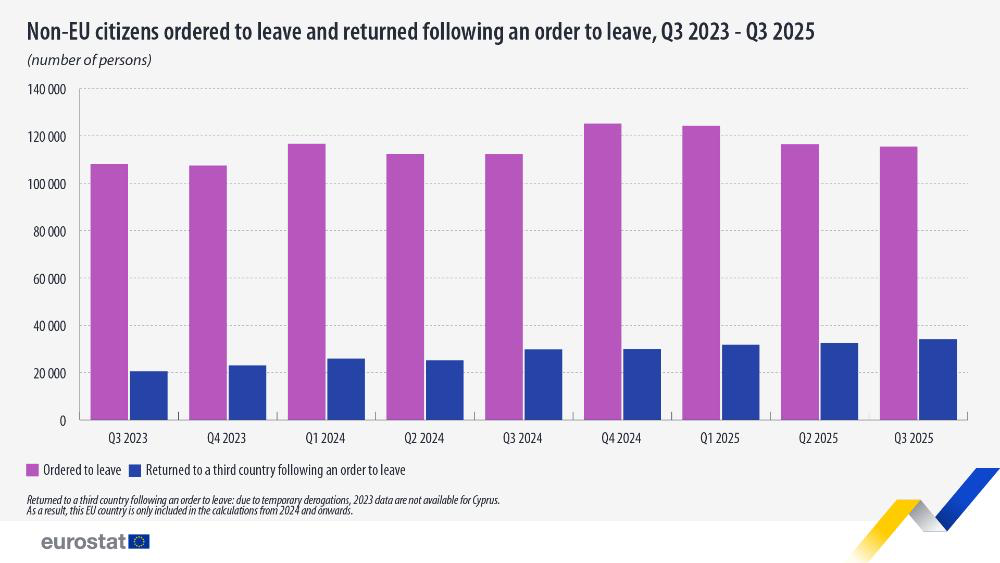
According to statistics published by Eurostat, between July and September 2025 a total of 115,440 non-EU citizens were ordered to leave the territory of a Member State of the European Union. Of these, 34,155 people were ultimately returned to a third country as a result of those decisions.
⏺️ Evolution compared with previous periods
Compared with the third quarter of 2024, the number of non-EU citizens ordered to leave an EU country increased by 2.7%. However, the most notable figure relates to effective returns, which rose by 14.6% year on year. When compared with the previous quarter, the number of orders to leave decreased slightly (-0.9%), while the number of people returned to third countries increased by 5.0%.
This development highlights that, although the overall volume of new administrative decisions remains relatively stable, Member States are progressively increasing the effective enforcement of return procedures.
⏺️ Main nationalities affected
Among non-EU citizens ordered to leave a Member State during the third quarter of 2025, the most affected nationalities were:
– Algeria: 12,325 people
– Morocco: 6,670 people
– Türkiye: 6,350 people
These figures reflect established migration patterns and particularly significant administrative pressure on certain nationalities within the framework of EU migration policy.
As regards those effectively returned to third countries, the most common nationalities were:
– Türkiye: 3,625 people
– Georgia: 2,835 people
– Albania: 2,055 people
The fact that Turkish nationals top the list for both orders to leave and effective returns indicates a higher rate of enforcement compared with other countries of origin.
⏺️ Member States with the highest number of orders and returns
By Member State, France recorded the highest number of orders to leave in the third quarter of 2025, with 33,760 administrative decisions, followed by Germany (12,510) and Greece (10,175). In terms of returns actually carried out, Germany clearly led with 7,190 people returned, followed by France (3,760) and Cyprus (3,000).
These figures reveal significant differences between Member States both in the issuance of return decisions and in their practical enforcement, reflecting diverse national approaches within the common EU framework.
⏺️ European context regarding return orders
The sustained increase in returns forms part of the European Union’s broader strategy to enhance the effectiveness of its migration policy, particularly with regard to the return of third-country nationals who are irregularly present. This trend is closely linked to ongoing debates on reforming the European asylum and migration system and to the development of a more harmonised common framework on returns.
From a practical perspective, these data confirm that the existence of an order to leave does not automatically lead to an immediate return, but they do show that the likelihood of enforcement is progressively increasing. For affected individuals, it is essential to understand the real scope of these decisions, the applicable time limits and the legal avenues that may be available in each specific case.
⏺️ How can ARC Legal Abogados help?
If you are affected by an immigration procedure, an order to leave, or an uncertain administrative situation in Spain or another EU Member State, having clear information and specialised legal advice can make a decisive difference.
At ARC Legal, we support individuals, families and companies in understanding their migration status and making informed decisions, analysing each case individually and with a practical view of the current European context. Acting at the right time makes it possible to anticipate risks, assess legal options and face any administrative procedure with greater confidence.
Related publications
- The European Union promotes a new common framework for the return of irregular third-country nationals
- Changes in nationality laws: what is happening in Portugal and the lesson for Spain
- Travelling to the Schengen area will be more expensive: ETIAS fee increases to 20 euros
¿Prefieres leer este artículo en español 🇪🇸? Enlace: Más de 115.000 ciudadanos no comunitarios recibieron una orden de salida en la UE en el tercer trimestre de 2025
The content of this article is for information purposes only and does not constitute legal advice. Immigration regulations are subject to ongoing legislative, administrative and interpretative changes. At ARC Legal, we make every effort to ensure that information is accurate and up to date based on official sources; however, we always recommend consulting a specialised professional before starting any procedure or taking legal decisions. If you require personalised advice regarding your situation, you may contact our firm.