

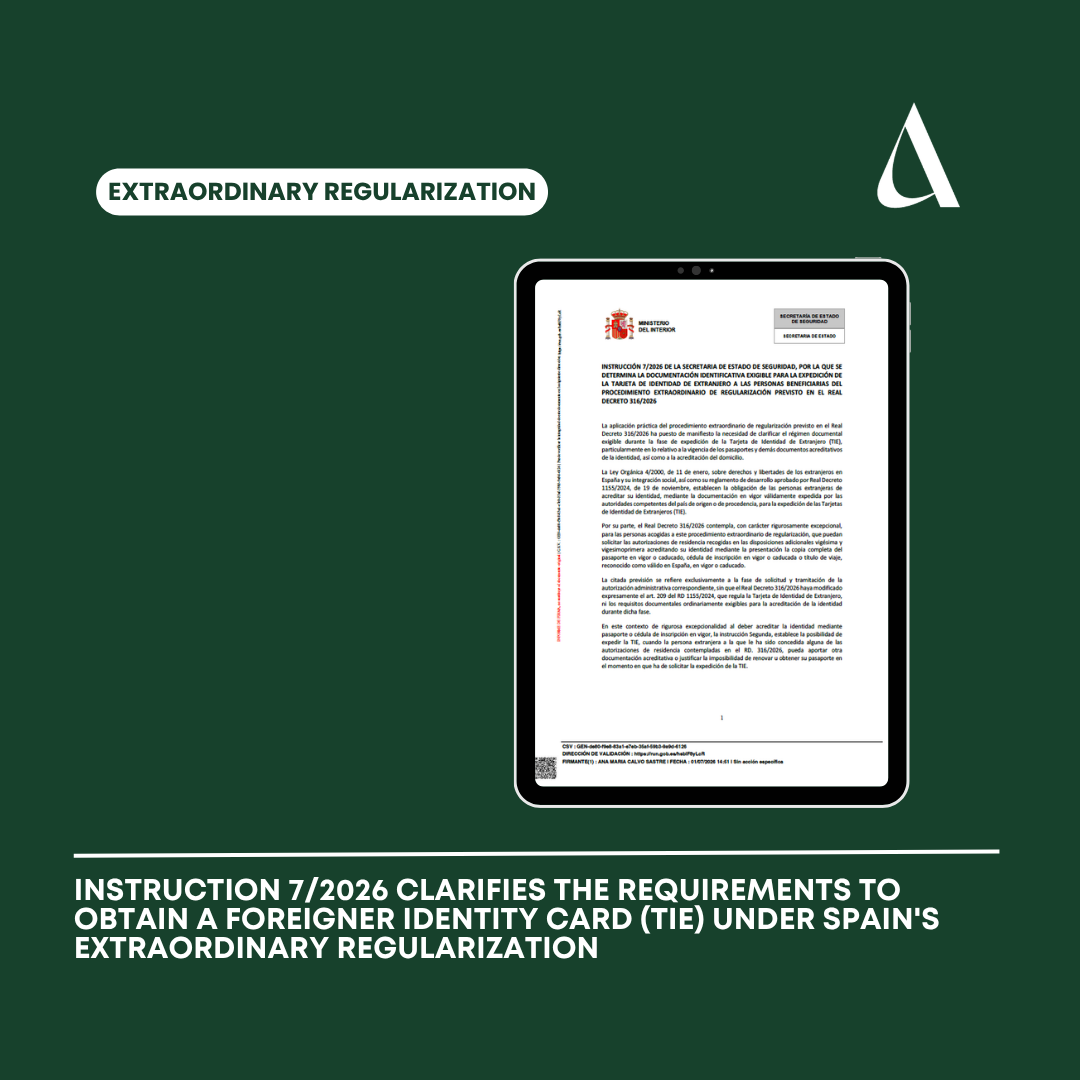
The Spanish Ministry of the Interior has approved Instruction 7/2026, dated July 1, with the aim of clarifying the documentation required for the issuance of the Foreigner Identity Card (Tarjeta de Identidad de Extranjero – TIE) to individuals benefiting from the extraordinary regularization process established under Royal Decree 316/2026.
This is a particularly important instruction, as it resolves some of the main questions that have arisen since the launch of the regularization process regarding the issuance of the TIE after a residence authorization has been granted.
Below you will find the full text of Instruction 7/2026, issued by the Secretary of State for Security (in Spanish):
⏺️ Why was this instruction necessary?
Royal Decree 316/2026 allowed thousands of individuals to apply for extraordinary regularization by proving their identity with a passport, cédula de inscripción, or travel document, whether valid or expired.
However, this flexibility only applied during the application stage.
The general regulations governing the Foreigner Identity Card (TIE) continued to require applicants to prove their identity, as a general rule, by presenting an original and valid identity document. This created uncertainty for many individuals who had already obtained a favorable residence decision but were still unable to renew their passport.
Instruction 7/2026 has been issued precisely to address this situation.
⏺️ General rule: original and valid passport
As a general rule, beneficiaries of the extraordinary regularization process must attend their TIE appointment with one of the following original and valid documents:
- Passport.
- Cédula de Inscripción.
- Travel document recognized by Spain.
The Instruction also confirms that the exceptional measures currently applicable to nationals of Venezuela and Belarus remain in force.
🚨 Spanish immigration regulations provide specific exceptions for nationals of Venezuela and Belarus regarding identity documentation. These measures recognize the practical difficulties many citizens of these countries face when renewing or obtaining a valid passport, allowing greater flexibility in certain immigration procedures.
– Venezuela
– Belarus
⏺️ Exceptions where it is not possible to renew a passport
The most significant aspect of the new Instruction is its express recognition that exceptional circumstances may prevent an individual from obtaining a valid passport.
In such cases, the National Police may still issue the TIE, provided that the applicant can demonstrate that they have attempted to renew their passport or that it is materially impossible to obtain a new one.
Examples of supporting evidence include:
- Proof of a consular appointment.
- Emails exchanged with the relevant consulate or diplomatic mission.
- Passport renewal application receipts.
- Any other evidence demonstrating the impossibility of obtaining a new passport.
This provision is particularly important for nationals of countries whose consulates are experiencing significant delays, administrative difficulties, or operational restrictions resulting from international conflicts.
⏺️ Changes to proof of home address
The Instruction also simplifies the rules regarding the address that will appear on the TIE.
As a general rule, the Spanish authorities will use the address declared by the applicant when submitting the extraordinary regularization application and recorded in the residence authorization decision.
Only where the applicant requests a different address to appear on the TIE will the Administration attempt to verify it electronically.
If electronic verification is not possible, or if the applicant objects to such verification, the authorities may request a municipal registration certificate (empadronamiento) issued no more than three months before the TIE application.
⏺️ How ARC Legal can help
At ARC Legal, we closely monitor every development relating to Spain’s extraordinary regularization process to provide our clients and readers with accurate, up-to-date, and practical information on the criteria being applied by the Spanish authorities.
In addition to analyzing new instructions and regulatory developments, we assist beneficiaries throughout every stage of the process—from the submission of the residence application to the issuance of the Foreigner Identity Card (TIE)—including document reviews, resolving procedural issues, and providing ongoing legal guidance.
If you have any questions, our team will be happy to assist you.
Related articles
- Foreign Identity Card – TIE | Madrid & Barcelona
- Spain’s Extraordinary Regularization exceeds 1.17 million applications
- European Commission proposes extending Temporary Protection for Ukrainians until 2028
¿Prefieres leer este artículo en español 🇪🇸? Aquí tienes el enlace: La Instrucción 7/2026 aclara los requisitos para obtener la TIE tras la regularización extraordinaria
The information contained in this article is provided for general informational purposes only and does not constitute legal advice. Immigration and international document regulations are subject to frequent legislative, administrative, and interpretative changes. While ARC LEGAL makes every effort to ensure that the information published is accurate and up to date, we recommend seeking professional legal advice before initiating any procedure or making decisions based on this content. If you require advice regarding your specific circumstances, please do not hesitate to contact our team.