

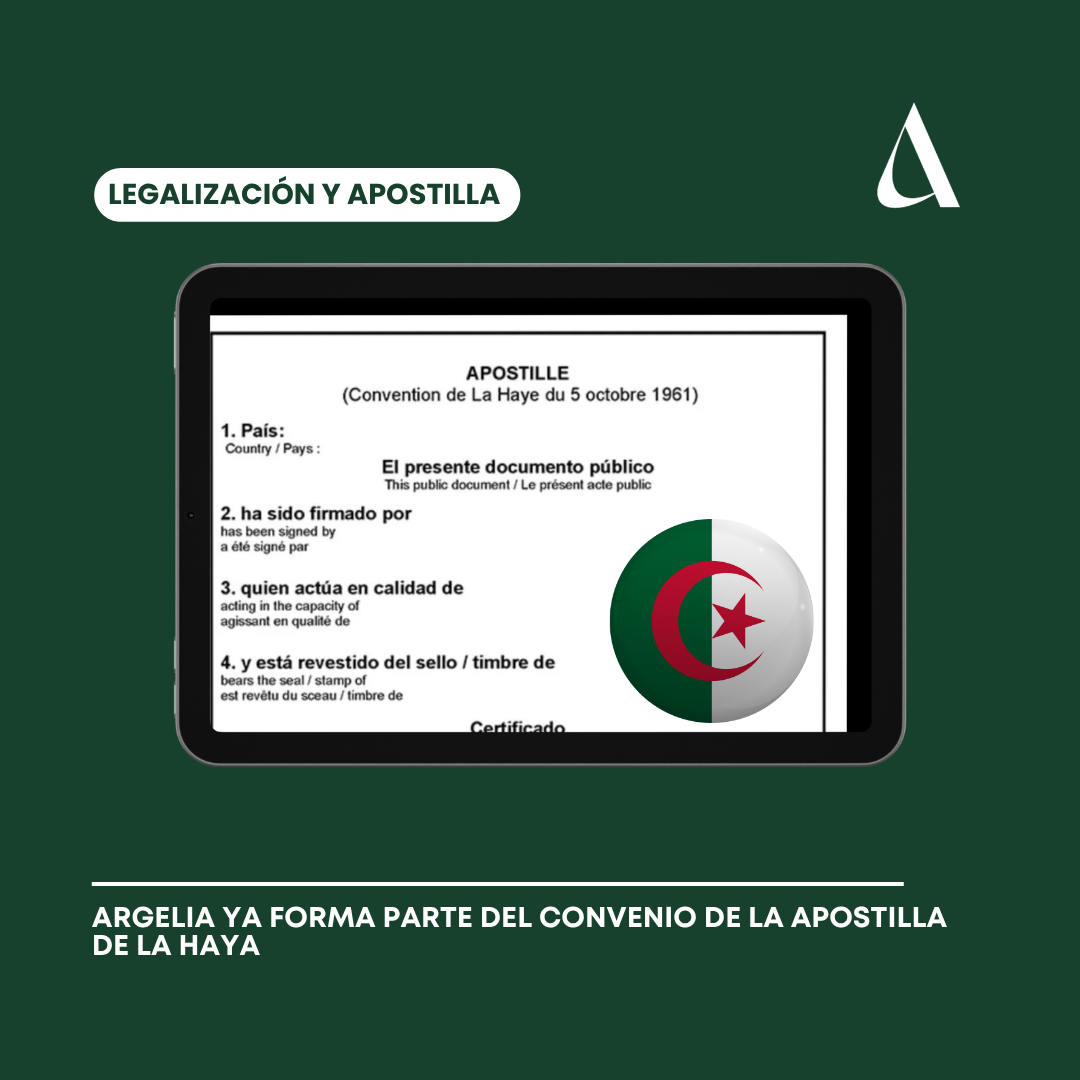
On July 9, 2026, the 1961 Hague Apostille Convention officially entered into force for the People’s Democratic Republic of Algeria, marking a significant milestone that will simplify the use of public documents between Algeria and the other Contracting Parties to the Convention, including Spain.
At ARC Legal Abogados, we reported this development back in November 2025, when Algeria deposited its instrument of accession to the Convention. At that time, we explained that, once the waiting period established by the treaty had elapsed, the Apostille would replace the traditional diplomatic legalization process. That moment has now arrived.
⏺️ What does this change mean?
Until now, a public document issued in Algeria that needed to be presented in Spain—or a Spanish public document intended for use in Algeria—generally had to go through a lengthy legalization process involving several authorities, including the relevant embassies or consulates.
As of July 9, 2026, that process has become much simpler.
In most cases, it will now be sufficient for the document to bear a Hague Apostille issued by the competent authority in the country where the document was issued.
This represents a significant reduction in processing times, administrative costs, and bureaucracy.
⏺️ Which documents benefit from this change?
Among others, the new system applies to documents such as:
- Birth certificates.
- Marriage certificates.
- Criminal record certificates.
- Notarial documents.
- Court decisions.
- Academic certificates and university degrees.
- Administrative certificates.
It is important to remember that an Apostille only certifies the authenticity of the signature, seal, and official capacity of the person who issued the document. Where required, a certified translation or other legal requirements may still apply.
⏺️ Algeria joins the Hague Apostille system
Algeria deposited its instrument of accession on November 5, 2025, and the Convention officially entered into force on July 9, 2026, becoming the country’s first treaty under the Hague Conference on Private International Law (HCCH).
With Algeria’s accession, the Hague Apostille Convention now has 130 Contracting Parties, reinforcing its position as one of the world’s most important international instruments for facilitating the cross-border use of public documents.
⏺️ How ARC Legal Abogados can help
At ARC Legal, we manage the apostille and legalization of Spanish documents intended for use abroad. We advise both individuals and businesses that need to prepare official documentation for international procedures.
Our offices are strategically located near embassies, consulates, and Spain’s main public authorities, allowing us to coordinate the required formalities efficiently while providing continuous support throughout the process.
Our services include the apostille or legalization of:
- Birth, marriage, and death certificates.
- Criminal record certificates.
- Notarial deeds and powers of attorney.
- University degrees and academic records.
- Certificates issued by public authorities.
- Corporate and commercial documentation.
Before starting any procedure, we review each document to determine whether the destination country requires a Hague Apostille or consular legalization, helping to prevent delays and unnecessary complications. Our goal is to ensure that your documents are properly prepared and accepted by the foreign authorities from the outset.
Related articles
- Vietnam joins the Apostille Convention
- Legalising a Spanish university diploma from abroad: what you need to know
- EUIPO legalization service: how to legalize Certificates and Extracts
¿Prefieres leer este artículo en español 🇪🇸? Aquí tienes el enlace: Argelia ya forma parte del Convenio de la Apostilla de La Haya
The information contained in this article is provided for general informational purposes only and does not constitute legal advice. Immigration and international document regulations are subject to frequent legislative, administrative, and interpretative changes. While ARC LEGAL makes every effort to ensure that the information published is accurate and up to date, we recommend seeking professional legal advice before initiating any procedure or making decisions based on this content. If you require advice regarding your specific circumstances, please do not hesitate to contact our team.