

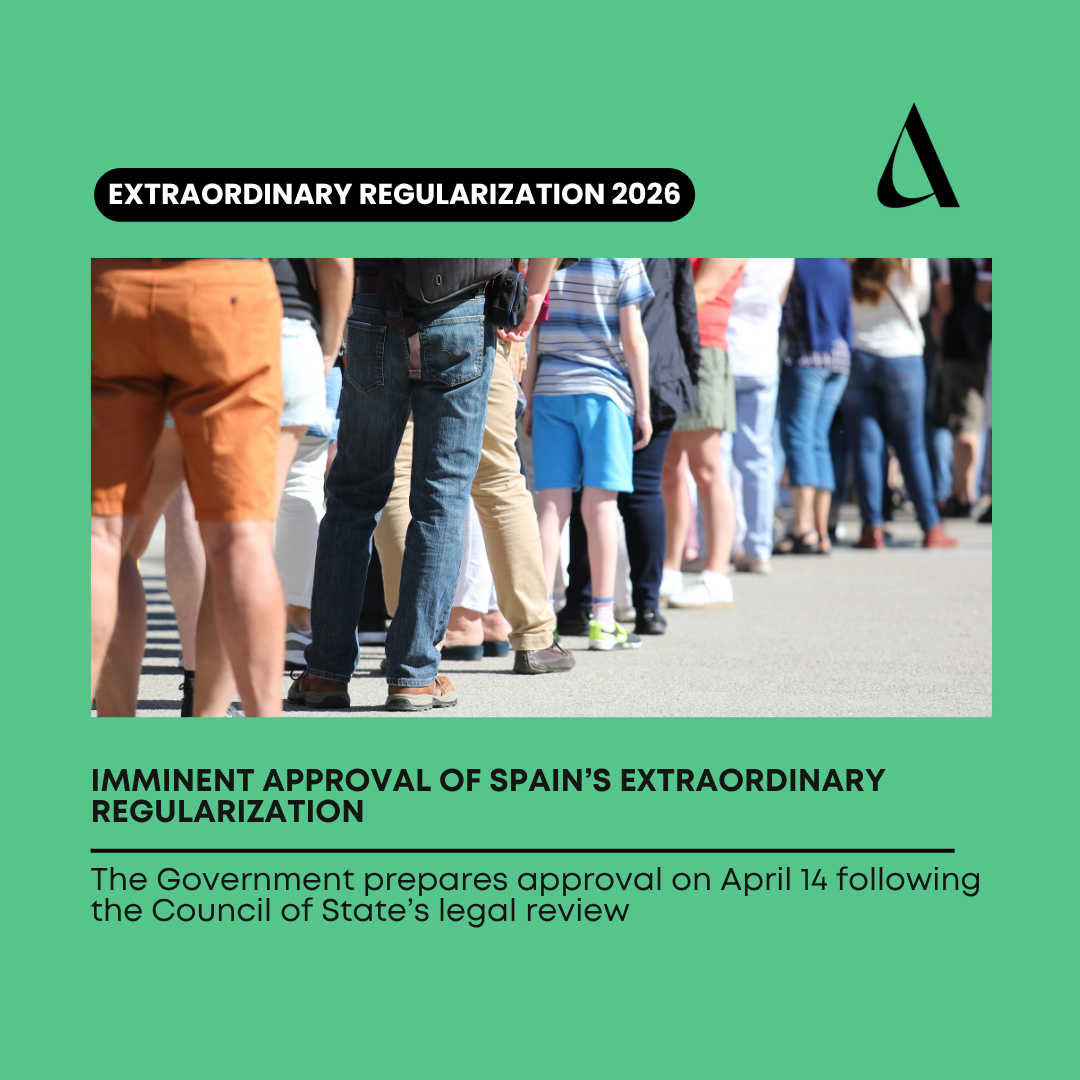
The extraordinary regularization process in Spain is entering its final stage.
With the opinion of the Council of State already issued and the draft text practically finalized, the Government is expected to approve the measure at the Council of Ministers meeting on April 14, following several weeks of technical adjustments and coordination between different ministries.
All indications suggest that the political decision has been made and that the regulation will be adopted imminently. This represents a significant shift in the current immigration landscape in Spain, particularly for individuals who are already living in the country in an irregular situation.
The Extraordinary Regularization has not yet been officially published. The Royal Decree regulating this process is still under legislative development, and its content may be subject to changes and amendments until its final approval and publication in the Official State Gazette (BOE). For this reason, it is advisable to rely only on official sources and to avoid making decisions based on unconfirmed information.
⏺️ Legal endorsement by the Council of State
As reported by El País, the draft has already passed one of the key stages of the process: the review by the Council of State. Its opinion, which is mandatory in this type of reform, broadly supports the measure and confirms its legal viability through an amendment to the Immigration Regulations.
This is a particularly important step. The validation by the Council of State not only strengthens the legal foundation of the regularization but also reduces the risk of legal challenges in a context where litigation is likely after its approval.
In addition, the technical observations made by this advisory body are currently being incorporated into the final version of the text, further enhancing its legal robustness and certainty.
⏺️ Imminent approval by the Council of Ministers
With the legal endorsement now essentially secured, the Government is finalizing the last technical adjustments ahead of formal approval.
All indications suggest that the extraordinary regularization will be approved at the Council of Ministers meeting on April 14, through a regulatory reform that does not require parliamentary approval, allowing for a significantly faster process.
If the expected timeline is maintained, the regulation will be published in the Official State Gazette (BOE) in the days following its approval, triggering the regularization procedure within a very short timeframe and marking the beginning of a key practical phase.
⏺️ What happens after approval
Once the regulation is approved by the Council of Ministers, several key steps will follow:
- Publication in the BOE
- Entry into force of the regulation
- Opening of the application period
- Activation of administrative procedures
Everything indicates that this will be an extraordinary, time-limited and fast-track process, requiring applicants to act quickly.
⏺️ How can ARC Legal assist you?
At ARC Legal, we assess your case on an individual basis to determine whether you may benefit from this extraordinary regularization and, most importantly, how to approach your application strategically.
These types of procedures require more than simply meeting the formal requirements. It is essential to properly prepare your documentation, anticipate potential risks, and submit a strong application from the outset—especially in a context of high demand and limited timeframes.
Our firm supports you throughout the entire process:
- Initial assessment of your case viability
- Full review and preparation of documentation
- Definition of the best legal strategy based on your situation
- Submission of the application and follow-up of the procedure
Our goal is to ensure that you can access this opportunity with the highest level of legal certainty, avoiding mistakes that could jeopardize your application.
Related publications
- Extraordinary regularization 2026: practical analysis for asylum applicants
- Extraordinary regularization 2026: Government publishes a second draft with key changes
- Which EU countries grant the most citizenships?
¿Prefieres leer este articulo en español 🇪🇸? Aquí te dejamos el enlace: Aprobación inminente de la Regularización Extraordinaria
The information provided in this article is for informational purposes only and does not constitute legal advice. While we strive to provide accurate and up-to-date information, immigration regulations are subject to change and interpretation by the competent authorities. For personalized and up-to-date legal advice, we recommend consulting with a qualified immigration lawyer.