

The United Kingdom’s departure from the European Union was not only a political shift, but also a turning point in the legal framework applicable to thousands of British citizens living in Spain. The Withdrawal Agreement introduced a specific regime to protect their rights, but it also triggered a large-scale documentation process that, even today, continues to raise practical questions.
Since then, obtaining the Foreigner Identity Card (TIE) under this regime has become a key step to prove legal residence in Spain. However, not all cases have been straightforward: proving prior residence, understanding the different application pathways, or even determining whether a document exchange is required remain common concerns.
The latest official data published by the Spanish Ministry of Inclusion, Social Security and Migration allows us to go beyond the legal framework and understand what has actually happened over the past few years: who has applied for these cards, where they are concentrated, and what profile they have. This analysis is particularly relevant to anticipate the next steps in a regime that is still evolving.
⏺️ Over 250,000 documents granted since 2020
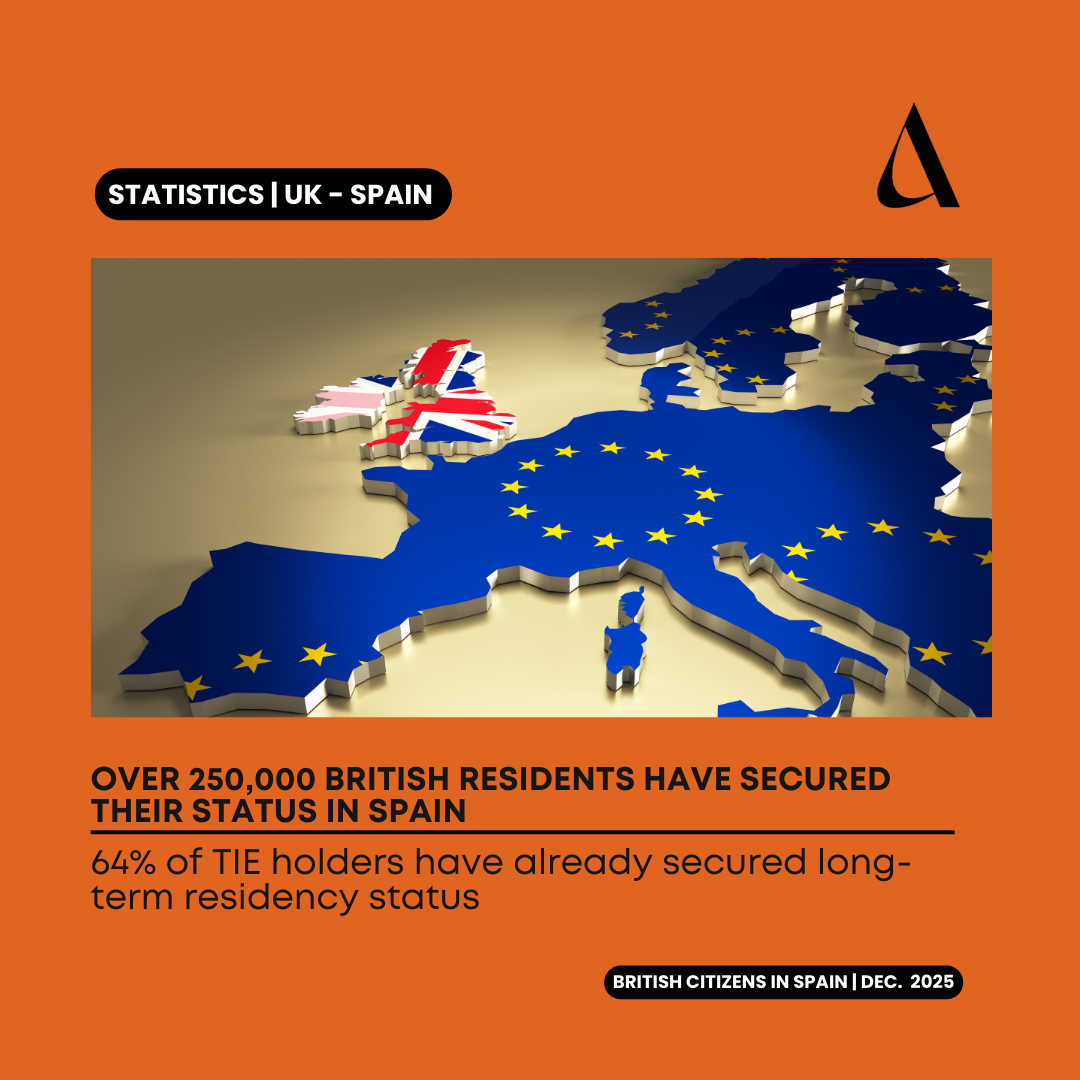
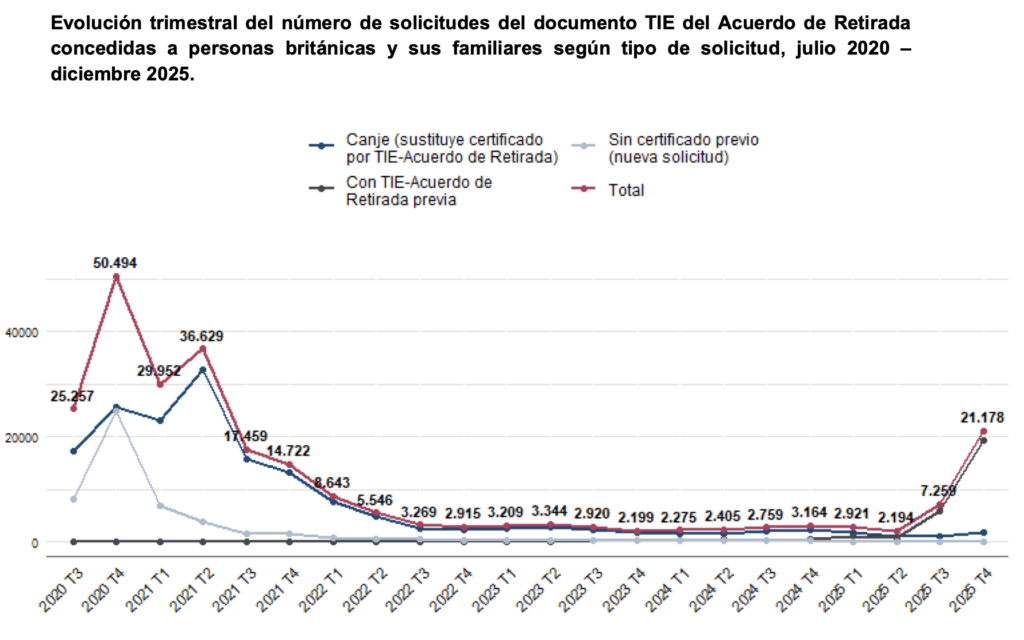
From July 2020 to December 2025, a total of 250,713 TIEs have been granted under the Withdrawal Agreement, representing approximately 89% of all applications submitted.
These approvals correspond to 228,940 individuals, which reflects that some applicants have received more than one decision over time (for example, renewals or changes in their administrative status).
Spain adopted a declaratory system, allowing British citizens to confirm their status as beneficiaries of the Withdrawal Agreement without undergoing a complex constitutive procedure.
⏺️ A process shaped by the exchange of previous documentation
One of the most significant aspects of the Brexit-related process has been the exchange of previous residence documentation for the new TIE specifically issued under the Withdrawal Agreement. This was not an entry process into the system, but rather a mandatory adaptation of already established situations.
The data clearly reflects this:
- 168,238 approved applications correspond to the exchange of registration certificates or previous residence cards
- 52,008 applications were processed without a prior certificate, proving residence through alternative means
- 30,467 applications correspond to individuals who already held a TIE and applied again for documentation
This confirms that most British citizens did not arrive in Spain after Brexit, but were already living in the country and had to adapt their status to the new legal framework. In practice, this process has led to numerous cases where it was necessary to reconstruct residence prior to December 31, 2020, particularly for those without a registration certificate.
From a practical perspective, this exchange has not always been automatic. In many cases, it has required a detailed review of documentation, proof of sufficient means, and continuity of residence, which explains part of the complexity that some cases still present today.
⏺️ Predominance of permanent residence
Another key aspect is the clear predominance of stable residence permits. Specifically, 64% of the TIEs granted have a permanent nature.
This figure is highly relevant from both a legal and practical standpoint. Permanent residence under the Withdrawal Agreement not only provides greater stability, but also consolidates a right of residence that is largely equivalent to what existed prior to Brexit, provided that the required conditions continue to be met.
In practice, this reflects that a large proportion of the British population has already moved beyond the initial adaptation phase and has consolidated their long-term residence in Spain. Many individuals who initially obtained temporary residence have progressively transitioned to permanent status, particularly from 2023 onwards, as they reached five years of continuous residence.
It is also important to note that, in these cases, what is renewed is not the right of residence — which is indefinite — but rather the physical residence card itself. This reduces the administrative burden in the long term, while still requiring the documentation to be kept up to date.
⏺️ An ongoing transition
Despite the high number of residence cards granted, the process is not yet fully complete. According to the available data, around 199,000 British citizens and their family members still hold previous EU registration certificates and have not yet exchanged them for the TIE.
This creates a relevant practical scenario: there remains a significant number of individuals who may need to regularize their documentation in the coming years.
⏺️ How ARC Legal can assist you
At ARC Legal Abogados, we assist British citizens and their families with all matters related to the Withdrawal Agreement, offering a practical and tailored approach to each case.
We can help you:
- Assess your current situation and confirm whether you qualify under the Withdrawal Agreement
- Apply for your TIE for the first time or carry out the document exchange
- Renew your residence card or transition from temporary to permanent residence
- Prepare your documentation properly to avoid requests for additional information or delays
- Review complex cases (extended absences, missing documentation, family or professional changes)
We understand that, while many procedures may seem straightforward, mistakes in documentation or strategy can lead to significant delays or even unfavorable decisions. That is why we work with you from the outset to ensure that your application is properly structured and aligned with the criteria applied by the authorities.
If you need legal assistance or would like us to review your case, feel free to contact us and we will assess your situation on a personalized basis.
Related publications
- Return Authorization for UK Nationals in Spain: Christmas 2025-2026
- British citizens in Spain: Five years after the withdrawal agreement (june 2025)
- British citizens living in Spain: get your TIE before the new EU border control system comes into effect
¿Prefieres leer este artículo en español 🇪🇸? You can find it here: Más de 250.000 británicos ya han regularizado su situación en España
The information provided in this article is for informational purposes only and does not constitute legal advice. While we strive to provide accurate and up-to-date information, immigration regulations may change and may be interpreted differently by the relevant authorities. For personalized and updated legal advice, we recommend consulting with a specialized immigration lawyer.