

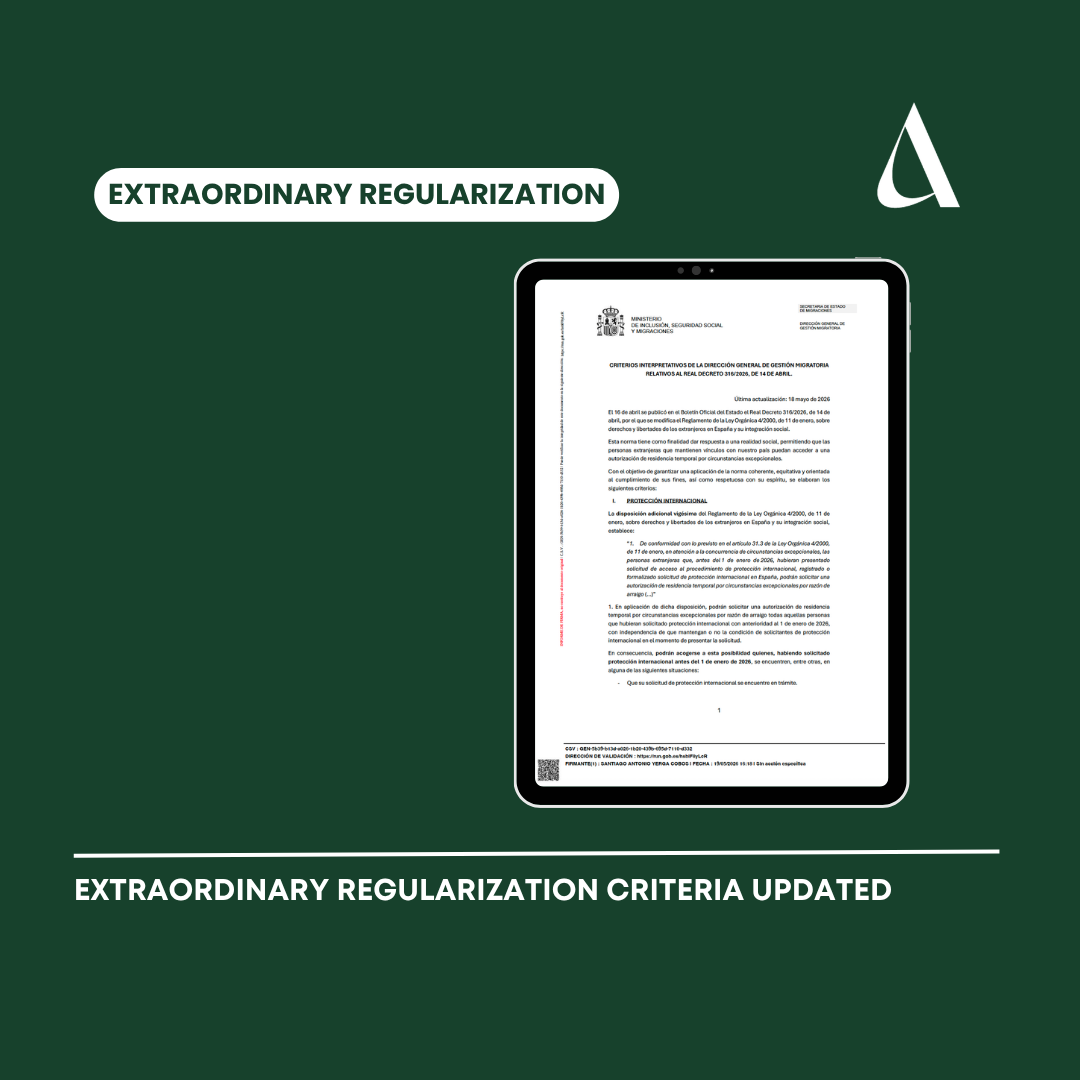
The Ministry of Inclusion, Social Security and Migration has published an update to the interpretative criteria relating to Royal Decree 316/2026, the regulation that establishes the extraordinary regularization process for certain foreign nationals in Spain.
The initial version of these criteria was published in April, just a few days after the Royal Decree entered into force. Now, in the updated version dated 18 May 2026, a relevant clarification has been introduced that may have a significant practical impact on many cases.
Below, you can access the full document containing the updated interpretative criteria published by the Secretariat of State for Migration for direct consultation:
At ARC Legal, we summarize the most relevant changes below.
⏺️ Important clarification for individuals who applied for international protection after 1 January 2026
This is, without doubt, the most significant change introduced in the update.
In the initial version of the criteria, the Ministry confirmed that individuals who had applied for international protection before 1 January 2026 could benefit from the extraordinary process, including situations where:
- Their application was still pending;
- They had withdrawn their case;
- Their application had been refused;
- They had an administrative or judicial appeal pending.
However, one important question remained unresolved: what about individuals who were already physically present in Spain before 1 January 2026, but only submitted their international protection application after that date?
The updated criteria now expressly clarify this point.
The Ministry confirms that these individuals may apply for temporary residence authorization based on exceptional circumstances under the extraordinary social integration route (arraigo extraordinario), provided they can prove their presence in Spain before the key cut-off date established by the regulation.
This clarification is particularly important because it prevents restrictive interpretations that could otherwise exclude individuals who, in practice, fall within the intended scope of the extraordinary process.
In simple terms: submitting an international protection application after 1 January 2026 does not automatically exclude someone from this regularization pathway.
⏺️ Clarification on who may sign the vulnerability certificate or report
Another change, although of more limited practical impact, concerns the vulnerability certificate or report.
In the initial version, the criteria stated that this document could be signed by any person who “forms part of” the competent social assistance entity.
The updated wording now states that it may be signed by any person who “works for” that entity.
This does not appear to be a substantive legal change, but rather a practical clarification that provides greater certainty and reduces the risk of overly restrictive interpretations regarding who is authorized to issue this type of document.
⏺️ Express inclusion of long-term residence holders in the transitional provisions concerning minors
The update also introduces a specific clarification regarding the transitional measures applicable to minors and dependent individuals with disabilities.
More specifically, it now expressly confirms that these provisions also apply to foreign nationals holding long-term residence authorization.
Although this interpretation could arguably already be defended from a legal perspective, the express inclusion removes interpretative uncertainty and provides greater clarity for affected individuals.
⏺️ A limited update, but with practical implications
When comparing both versions as a whole, the reality is that no structural changes have been made to the functioning of the extraordinary process.
The general requirements remain unchanged, as do the deadlines and the transitional framework already announced.
However, the new clarification regarding international protection applicants does have a clear practical impact and may create opportunities for individuals who, until now, were in a legal grey area.
As with any extraordinary immigration process, strategy must be assessed on a case-by-case basis, particularly where there is a history of international protection claims or complex immigration circumstances.
⏺️ How can ARC Legal help?
Every immigration case is different, and even a small difference in your personal or administrative situation can completely change the most appropriate legal strategy.
At ARC Legal, we advise foreign nationals and families on all types of immigration procedures in Spain, including residence authorizations, visas, social integration routes (arraigo), renewals, family reunification, Spanish nationality applications, and complex cases involving previous international protection claims.
If you would like to assess your case or determine the most suitable pathway to regularize your immigration status in Spain, we would be pleased to assist you.
Related publications
- New interpretative guidelines on Spain’s Extraordinary Regularization
- Extraordinary Regularization in Spain: How to demonstrate your eligibility
- Administrative Fees in Spain’s Extraordinary Regularization
¿Prefieres leer este artículo en español 🇪🇸? Aquí te dejamos el enlace: Regularización extraordinaria: el Ministerio actualiza los criterios y aclara nuevos supuestos
The information provided in this article is for informational purposes only and does not constitute legal advice. While we strive to provide accurate and up-to-date information, immigration regulations are subject to change and interpretation by the competent authorities. For personalized and up-to-date advice, we recommend consulting a qualified immigration lawyer.